Abba, Father
The icon of the Father: a symbol, not a portrait
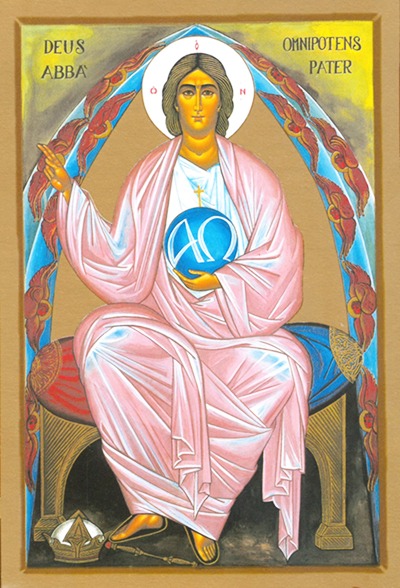
No one has ever seen the Father. And yet there is an icon of the Father, painted by the iconographer Lia Galdiolo, grandmother and teacher of Concetta Basile. To understand it we must remember what an icon is: not a photograph of a person, but a language of signs. It does not show what someone looks like; it tells who they are, through episodes, gestures, colours, light and gold.
The icon is a symbolic language
The Catechism of the Catholic Church says it clearly: the icon «cannot represent the invisible and incomprehensible God»; it is the incarnation of the Son of God that «has ushered in a new "economy" of images» (no. 1159). And it adds: «Christian iconography expresses in images the same Gospel message that Scripture communicates by words. Image and word illuminate each other» (no. 1160).
The icon, then, is read as one reads a text. The Holy See's Directory on Popular Piety and the Liturgy says that sacred images «belong to the realm of sacred signs» and that their primary function «is not, however, to evince aesthetic pleasure but to dispose towards Mystery» (no. 243). And again: «The image is not venerated in itself. Rather, that which it represents is venerated» (no. 241). This is the rule set by the Second Council of Nicaea in 787 with the words of Saint Basil: the honour paid to the icon passes to its prototype.
John Paul II, in the apostolic letter Duodecimum saeculum (1987), writes that Church art must «speak the language of the Incarnation» and that the icon «is an image that turns towards us the look of Another invisible one» (no. 11). Benedict XVI, presenting Saint John Damascene, the great defender of icons, recalled that the saint can in no way be identified with the material the icon is made of.
This is why nothing in an icon is left to chance, and nothing is to be taken literally as in a portrait. The signs are read:
- Gold: not an ornament, but the uncreated light of God. The gold ground lifts the image out of earthly space and time. Pavel Florensky devoted famous pages to gold and light in his essay «Iconostasis».
- Light: in the icon there is no outside light source casting shadows. Light comes from within the figures; the highlights, laid last by the iconographer, are the sign of transfiguration, not the lighting of a room.
- Shadows: they are not natural shadows, but the dark ground from which the figure emerges, layer after layer, towards the light, as the human person walks from darkness into light.
- Colours: they carry meaning. Blue speaks of divinity and heaven, red of love and life, green of new life, white of glory. The garments are read like an inscription.
- Hair and beard: they say something about the person, not about their appearance. The white hair of the «Ancient of Days» of the prophet Daniel speaks of eternity; the young face of a saint who died young recalls a life offered.
- Gestures and objects: the blessing hand, the scroll, the book, the cross, the sphere. They are the «words» with which the icon tells episodes and spiritual qualities.
- Inscriptions: it is the written name that makes the icon what it is. Without the name the image does not say who it is; with the name, it points to them.
The image of the Father in the Catholic Church
The Western Catholic Church, unlike the Orthodox Church, has for centuries accepted the image of the Father as a venerable elder. Pope Benedict XIV, in 1745 (Sollicitudini Nostrae), considered it legitimate because it refers to the «Ancient of Days» of Daniel. The criterion is that the image be a symbol grounded in a biblical figure, not a portrait. No one claims that the Father "looks like this".
Daniel's text reads: «As I watched, thrones were set in place, and an Ancient of Days took his throne. His clothing was white as snow, and the hair of his head like pure wool» (Dan 7:9). The white hair does not describe a face: it puts the prophet's word into an image, the eternity of the One who is before all time.
The brief Sollicitudini Nostrae, signed by Benedict XIV on 1 October 1745 and addressed to the prince-bishop of Augsburg, divided images of the Trinity into approved, tolerated and prohibited. Among the approved were the Father as the «Ancient of Days», Christ in his human form and the Holy Spirit as a dove or tongues of fire: all forms in which God showed himself in Scripture.
The Orthodox tradition is more reserved: the Great Council of Moscow of 1666-1667 judged it improper to paint the Father as an old man, because no one has seen him in his divinity, and it prefers to show the Trinity through the three angels of Mamre. Two sensibilities guard the same truth: the Father has no face to portray, and every image of him remains a sign.
Abba: the name of a relationship
"Abba" is not a name that describes God "in himself". It is the relational name with which the Son addresses the Father: «Abba, Father, all things are possible for you» (Mk 14:36). It is also the cry the Spirit places on the lips of believers (Rom 8:15; Gal 4:6). It is a word no one can say on their own, but only by sharing in the Son's relationship.
To inscribe "Abba", then, is to say: this image does not show what the Father looks like, but how we, sons and daughters in the Son, call upon him. Paradoxically, the name strengthens the very principle we began with. The Father is known through the Son and in the Spirit, not in a form of his own. The image remains a symbol, and the name points to its meaning: a relationship, not a portrait.
"Abba" is perhaps the most fitting name for an image of the Father. It does not ask us to believe in the painted face, but to enter into the prayer of the Son.
The Aramaic word was kept as it is in the Greek Gospels, «Αββα ὁ πατήρ», and in the Latin Vulgate, «Abba Pater»: this is why it can be written on an icon in Greek or in Latin.
Paul says that the Spirit makes Christians cry out “Abba, Father!”. Later studies, in particular that of James Barr, have shown that adults too used Abba to address their father. It was a familiar and affectionate word, but also a respectful one: closer to “my father” than to “daddy”. It remains true that addressing God in so direct and personal a way was a distinctive feature of Jesus' prayer.
In Romans 8:15 he says that believers have received «a Spirit of adoption, through which we cry, Abba! Father!». In Galatians 4:6 he says that «God has sent the Spirit of his Son into our hearts, crying out, Abba! Father!». For Paul, then, it is not the boldness of individuals: it is the Holy Spirit himself who places this word on the lips of Christians. The Catechism of the Catholic Church takes up these texts when commenting on the Our Father (nos. 2777-2782).
Lia Galdiolo's icon of the Father
This icon is not by Concetta Basile, but by her grandmother Lia Galdiolo. To make the Father known in Eastern Europe, where devotion is lived through icons, the White Army (Armata Bianca) commissioned from her an image linked to the Message received by Mother Eugenia Ravasio in 1932. It was presented as the first icon of the Father in the world, during a prayer vigil at Sassone, near Rome. An icon of the Father by Lia Galdiolo is today in the Pro-Cathedral of God the Merciful Father in Zaporizhzhia, Ukraine, and her model has been taken up by other iconographers, such as Sister Maria di Gesù at the Porta del Cielo workshop, with the icon «Deus Pater Omnipotens – Abbà Pater».
Lia Galdiolo did not paint the white-haired elder of the Western tradition. According to the descriptions published by the apostolates that spread her icon, the Father has a beardless face and black hair, sign of the «divine darkness», the inaccessible mystery of God. It is the clearest proof that in an icon hair does not describe a person: white in Daniel to speak of eternity, black in Lia's icon to speak of mystery, it always remains a sign to be read.
At the top, on either side of the Father, the icon bears the Latin inscription «DEUS ABBA – OMNIPOTENS PATER»: God, Abba, Father almighty. Lia Galdiolo wrote on the panel the very name of the relationship: this image does not show what the Father looks like, but how we, sons and daughters in the Son, call upon him.
Icon of the Father – Lia Galdiolo
Lia Galdiolo's icon of the Father, the first in the world: «Deus Abba – Omnipotens Pater», the Father blessing with the blue sphere, the twelve seraphim, the crown and sceptre laid down. Photo: dioepadre.org.
Meaning of the icon of the Father
The meaning of Lia Galdiolo's icon, explained element by element beside the image of each detail, in simple words and in keeping with the iconographic tradition. The explanation follows the presentation of the icon published by the Dio è Padre website, which is also the source of the detail images.
1 - The title
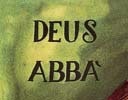
The almighty Father wishes people to be able to contemplate his face through an image that can be seen and touched: an icon.
He is the God of mercy and patience, from whom every good comes, who wants to bring back to himself hearts wounded by evil.
Who is the Father? The title written at the top tells us. «Deus omnipotens»: God holy and almighty. «Abba – Pater»: the name with which Jesus of Nazareth, and with him all his brothers and sisters, calls him Dad (Mk 14:36).
Those who followed the birth of this icon saw in it the sign of the Father's will: an image dear to him, carrying a special spiritual strength.
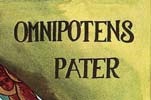
According to its presentation, what the icon expresses is faithful to the traditional doctrine of the Church and to recent private revelations judged serious and approved by the Church. Used in the right way, it is a precious help for the spiritual life: a beautiful and lofty means of contemplative prayer.
Lia Galdiolo says she always sought to «condense into images the richness of the biblical texts». After long study of the classical form of the icon, she developed a personal style, already known for her icons of the Woman clothed with the sun, the Merciful Jesus, the Holy Family and Saint Joseph.
The icon of the Father, she says, was born and matured in fasting, silence, prayer and suffering.
2 - A window for contemplating the divine
The panel is a rectangle. Its four sides recall the four points of the compass: the Father's message is addressed in every direction, to the whole world.
The rectangle is the earth, and on this earth a window opens onto heaven, with a gilded inner frame. In the icon gold is eternal light: this is why the icon is a window through which the divine is contemplated, and here we contemplate the Father. A thin red border closes the panel on the outside: it is the blood shed by Jesus on the cross, whose fruits we receive with the gift of the Holy Spirit. On the Father's forehead a small white figure can be glimpsed, like a dove with open wings above the eyebrows. The three Persons of the Trinity never act apart: the icon is of the Father, but the Son and the Holy Spirit are present too.
The materials of the panel also have a meaning: the three kingdoms of nature are represented in them.
It is an important detail for grasping the full richness of the icon.
The vegetable kingdom is the wood. The animal kingdom is the shell powder, the rabbit-skin glue coating the panel and the egg with which the colours are tempered.
The mineral kingdom is in the colours, made of metal oxides and ochres, and in the gold.
The panel is prepared like a cradle to receive the mystery, as God prepared creation to receive man, called to be its king.
Behind the simple bench on which the Father sits, and at the top around the inscriptions, the ground is dark, almost black, uneven and restless. It is the shadow that fell on the garden of Eden like a fog that spoils and saddens: the long winter that began when man wanted to decide by himself what is good and what is evil.
It is the dark fog of sin.
3 - The blue sphere
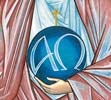
With his left hand the Father holds a blue sphere close to his breast. It is the most important element of the icon, and it is not only the world.
After Adam's disobedience the Father steps aside, respects man's freedom and waits patiently for him to recognise his error and return.
The waiting lasts for millennia, and meanwhile the Father, with his merciful heart, prepares the plan of redemption.
This plan is fulfilled with the coming of the Son made man, who through his Passion and Death makes it possible once more for man to receive the Holy Spirit.
With the «it is finished» spoken by Jesus on the cross, the project the Father carries in his heart sets out again: to make man a sharer in the divine life and, through him, to make all creation new.
This is exactly what the blue sphere says: it is the Father's plan of love, which he holds to his heart and keeps firm in his hand. Blue shows that the plan, from beginning to fulfilment, is God's work.
The alpha and omega filling the sphere recall the Word, beginning and end of all things: «All things came into being through him and for him» (Jn 1:3).
Above the sphere is the golden cross, throne of the Lamb who was slain and gave his life for all.
Gold is eternity: the Fathers of the Church say that the cross was written in the Father's heart from all eternity.
So a simple sphere, gently held in the left hand, contains the whole history of salvation.
4 - The figure of the Father fills the whole icon
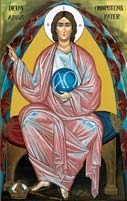
The Father is painted fully frontal: he shows himself to anyone who wishes to know him.
The figure stands in front of the golden mandorla painted behind him, within which the heavens open.
The blue heavens are the dwelling of the heavenly spirits, nearest to God's throne. The twelve flames crossing them are all the hosts of angels: in them the seraphim, «the burning ones», can be glimpsed, six on the right and six on the left.
The seraphim gaze in wonder at the work of the Father, who never ceases to act with his infinite love and his endless mercy.
Twelve is the number of entrusted authority: twelve are the apostles, the patriarchs, the stars crowning the Woman clothed with the sun. The twelve seraphim not only contemplate, but faithfully carry and carry out the Father's will.
5 - The face
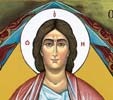
Philip said to Jesus: «Lord, show us the Father, and we will be satisfied». And Jesus answered: «Philip, whoever has seen me has seen the Father» (Jn 14:9).
Jesus meant that he acts as the Father does and fulfils his will in everything.
But how can one paint the face of the One who cannot be painted?
Western art has always shown the Father as a kind and solemn elder with a long white beard.
Lia Galdiolo observes, however, that the beard belongs to man made of flesh, and that a white beard is the sign of a body growing old.
The Father is pure spirit, and these features do not suit him. The monk and iconographer Andrei Rublev had understood this in his famous Trinity: this is why Lia drew inspiration from that icon, both for the beardless face and for the colours of the tunic and mantle.
Here then, according to the canons of the Eastern tradition, is a majestic face that conveys peace, strength and serenity.
Around the head a white halo, sign of glory, with the Greek letters Ὁ ὬΝ of the name God revealed to Moses on Horeb:
«I am who am» (Ex 3:14): the One who has always existed.
The black hair is the «divine darkness», the mystery of God, too deep for the human mind. It parts in the middle of the forehead like a veil, like the sky opening to let the light through.
Fine lines of gold run over the hair. They recall the veil of the Holy of Holies in the temple of Jerusalem, torn from top to bottom when the heart of Christ was pierced by the lance: since then enmity with God has been taken away and man can once again contemplate his face. This is what that hair, black and golden at once, tells us.
The small lips are in the act of breathing the Spirit who gives life; the slightly swollen neck shows this too.
The eyes look everywhere, they look on everyone with love and tenderness, and they await an answer from each of us.
Behind the shoulders the third heaven can be glimpsed, the eternal happiness to which the Father wants to lead us all.
6 - The tunic and the mantle
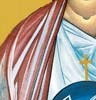
The Father wears a blue tunic and a red mantle, which say who he is for us: blue is divinity, red divine wisdom and burning love.
They are clear, transparent, almost weightless colours, as if shot through by the light of the Transfiguration.
The great, ample mantle is welcome. Its hem comes down to the ground so that anyone who wishes may take hold of it and receive the Holy Spirit. To receive that mantle is like receiving a precious inheritance to be faithfully guarded, as Elisha did when he gratefully received the mantle of Elijah (1 Kings 19:19).
7 - Significant details
A few details rich in meaning remain: the bench, the two cushions, the right hand, the sceptre, the crown and the position of the feet.
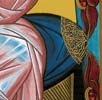
a) The Father does not sit on a throne, but on a simple bench: he wants us too to sit beside him without hesitation and without fear. And yet his divine presence clothes it with rays of gold.
b) The two cushions, the blue one on the left for God and the red one on the right for man, say that God and man can once again be together and speak to each other, as at the beginning of creation.
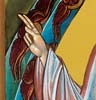
c) The right hand is raised in a broad blessing: as a good Father, he does not want to condemn the world but to save it, and he confirms the mission entrusted to the Son. Jesus in fact says: «Go and learn what this means: I desire mercy, not sacrifice. For I have come to call not the righteous but sinners» (Mt 9:13).
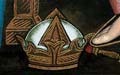
d) The sceptre, sign of judgement, is laid on the ground between his feet: now the Father wants to use only mercy.
e) The royal crown, beside the sceptre and the right foot, invites us not to be afraid to come near him. The Father wants to take away all awe, draw us to himself and welcome us onto his knees.
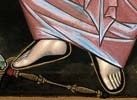
f) Though he is seated, his feet are those of someone about to set out: the Father always wants to come to meet us.
The feet too are surrounded by the halo of holiness. The black around them is not sandals, but again the «divine darkness»: the riches and wisdom of God, which we never finish understanding.
Every detail, then, is theology and at the same time a concrete help to devotion and to the spiritual life.
But an icon is not studied: it is contemplated. It was born in prayer, and it is to be used in prayer and for prayer; so it becomes a strong help towards union with God.
Before the icon the person depicted draws near and becomes present: here it is the Father himself who becomes present and at work.
May this icon help each person to meet the almighty Father with the affection and trust of a child.
Rights to the icon of the Father
The icon of the Father is the work of Lia Galdiolo. Concetta Basile, her granddaughter and heir, holds its rights: for any use of the icon, such as reproductions, prints, devotional images and publications, please contact her personally, on WhatsApp, on Telegram or by booking an appointment.
The same applies to the newly conceived icons conceived and painted by Concetta Basile, such as Saint Joseph the Nourisher and Saint Hilarion. The subjects and canons of iconography belong to the Tradition of the whole Church; the composition of each individual icon, the way the iconographer arranges figures, gestures, symbols and colours, remains their own work and bound to their name.
Further reading: how to read an icon
Those who wish to learn to read the signs of the icon can begin with a few classic texts: Pavel Florensky, «Iconostasis»; Leonid Ouspensky and Vladimir Lossky, «The Meaning of Icons»; Leonid Ouspensky, «Theology of the Icon»; Egon Sendler, «The Icon: Image of the Invisible». They belong to the school from which Concetta Basile also comes: an icon is not looked at like a painting; it is read and prayed.
Frequently asked questions
Can God the Father be painted in an icon?
The Father did not become incarnate and no one has seen him: this is why the Catechism recalls that the icon «cannot represent the invisible and incomprehensible God» (no. 1159). The Catholic Church nonetheless admits the image of the Father as a symbol grounded in Scripture, the «Ancient of Days» of Daniel 7:9: Benedict XIV, in the brief Sollicitudini Nostrae of 1745, counted it among the approved images. The Orthodox tradition is more reserved and prefers the Trinity of the three angels of Mamre.
Is the icon of the Father a portrait of God?
No. No one claims that the Father "looks like this". The icon is a symbolic language: hair, colours, gold, light, gestures and objects are signs pointing to what Scripture reveals of him, not a description of his appearance.
Why does the Father have black hair in Lia Galdiolo's icon?
According to the descriptions of the icon, the black hair signifies the «divine darkness», the inaccessible mystery of God. In the Western tradition the Father instead has the white hair of Daniel's Ancient of Days, sign of eternity. In both cases the hair does not describe a face: it is a sign to be read.
What does «Abba» mean?
It is the Aramaic word with which Jesus addresses the Father in Gethsemane: «Abba, Father, all things are possible for you» (Mk 14:36). Saint Paul places it on the lips of believers, who in the Spirit cry «Abba! Father!» (Rom 8:15; Gal 4:6). On an icon it says that the image does not show what the Father looks like, but how we, children in the Son, call upon him. Lia Galdiolo's icon of the Father bears precisely the inscription «Deus Abba – Omnipotens Pater».
Who painted the first icon of the Father?
The Paduan iconographer Lia Galdiolo, grandmother and teacher of Concetta Basile, commissioned by the White Army (Armata Bianca): her icon, linked to the Message of Mother Eugenia Ravasio, was presented as the first icon of the Father in the world. An icon of the Father by her is in the Pro-Cathedral of God the Merciful Father in Zaporizhzhia, Ukraine.