Eleousa · Vladimirskaya
The Theotokos of Vladimir: history, miracles and a hand-painted icon
Painted in Constantinople at the beginning of the twelfth century, the Theotokos of Vladimir has crossed almost nine centuries and three capitals. It is the model of every icon of Tenderness: the Child pressing his cheek to his Mother's, her gaze turned towards us, already heavy with the Passion.
From Constantinople to Kyiv
Tradition traces the prototype of this image to one of the icons attributed to the evangelist Luke. The icon we know was painted in Constantinople and, around 1130, came as a gift to Prince Mstislav of Kyiv; it was placed in a monastery at Vyshgorod, not far from the city.
In 1155 Prince Andrei Bogolyubsky, later venerated as a saint, took it north with him. The traditional account tells that the horses carrying it stopped and would go no further: on that spot the prince built a monastery, and the icon was placed in the Dormition Cathedral of Vladimir, from which it took its name.
The miracle of 1395: Tamerlane withdraws
In 1395 the army of Tamerlane was advancing on Moscow. Grand Prince Vasily I had the icon brought from Vladimir to Moscow; the people went out to meet it in procession, kneeling along the roads. According to the Tale of the Vladimir icon, the main source for these events, in those very days Tamerlane ordered his troops to withdraw.
At the place where the icon was met the Sretensky (Meeting) Monastery was founded, and the Russian Church remembers the miracle on 26 August (8 September in the civil calendar). From then on the icon remained in Moscow, in the Dormition Cathedral of the Kremlin, where the tsars were crowned and the patriarchs chosen.
Today, at the Tretyakov Gallery
Since 1930 the icon has been kept at the Tretyakov Gallery in Moscow and is displayed in the church of Saint Nicholas in Tolmachi, the Gallery's church, where the faithful can pray before it. Over the centuries it was repainted several times; restorers have uncovered the original layers, and the faces of the Mother and Child are the oldest part to have come down to us.
How to read the icon
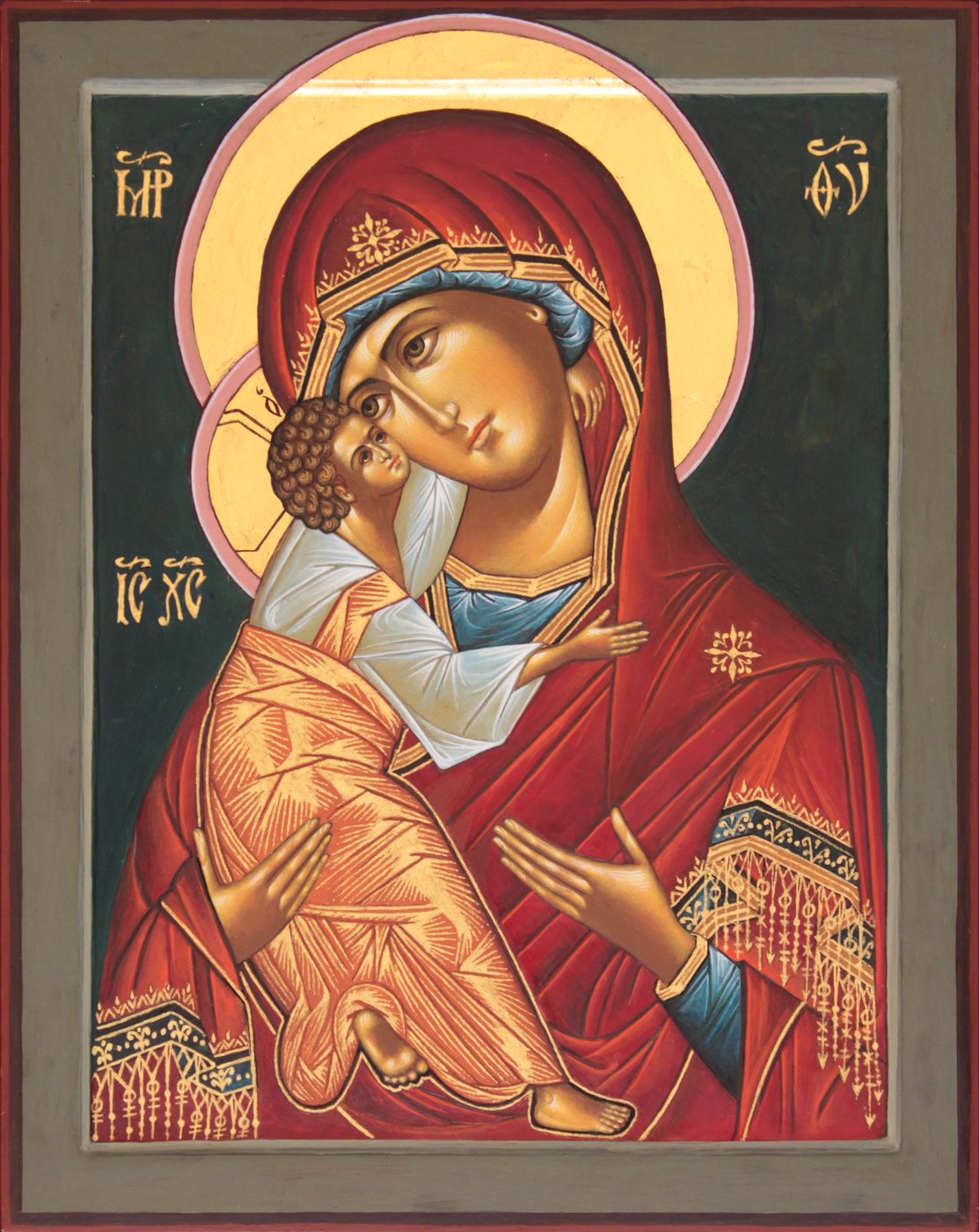
- The Child sits on his Mother's right arm and rests his cheek against hers: the embrace of the Eleousa, Tenderness.
- With his left hand the Son encircles his Mother's neck, beneath the mantle.
- The sole of the Child's foot shows beneath his garment: a characteristic detail of the Vladimir type.
- The Mother looks not at her Son but at the one who prays: her gaze is veiled by awareness of the Cross.
- Mary's left hand opens towards the Child, in a gesture of prayer and offering.
Concetta Basile's Virgin of Vladimir
In the Theotokos of Vladimir painted by Concetta Basile the purple-red mantle, edged with gold, enfolds the two figures against the dark green ground; the Child's garment is crossed throughout by gold highlights, the light of divinity. Beside it, two more icons of the same family: the Theotokos of Korsun, where the two figures hold each other in an even closer embrace, and a Tenderness with a red mantle. Like every icon by Concetta Basile, it is fully gilded with 23¾ karat gold, with inscriptions in Greek or Latin, and is commissioned with an offering proportionate to the time and materials of the work.
Theotokos of Vladimir
Eleousa, dark green ground, the Child's garment with gold highlights.
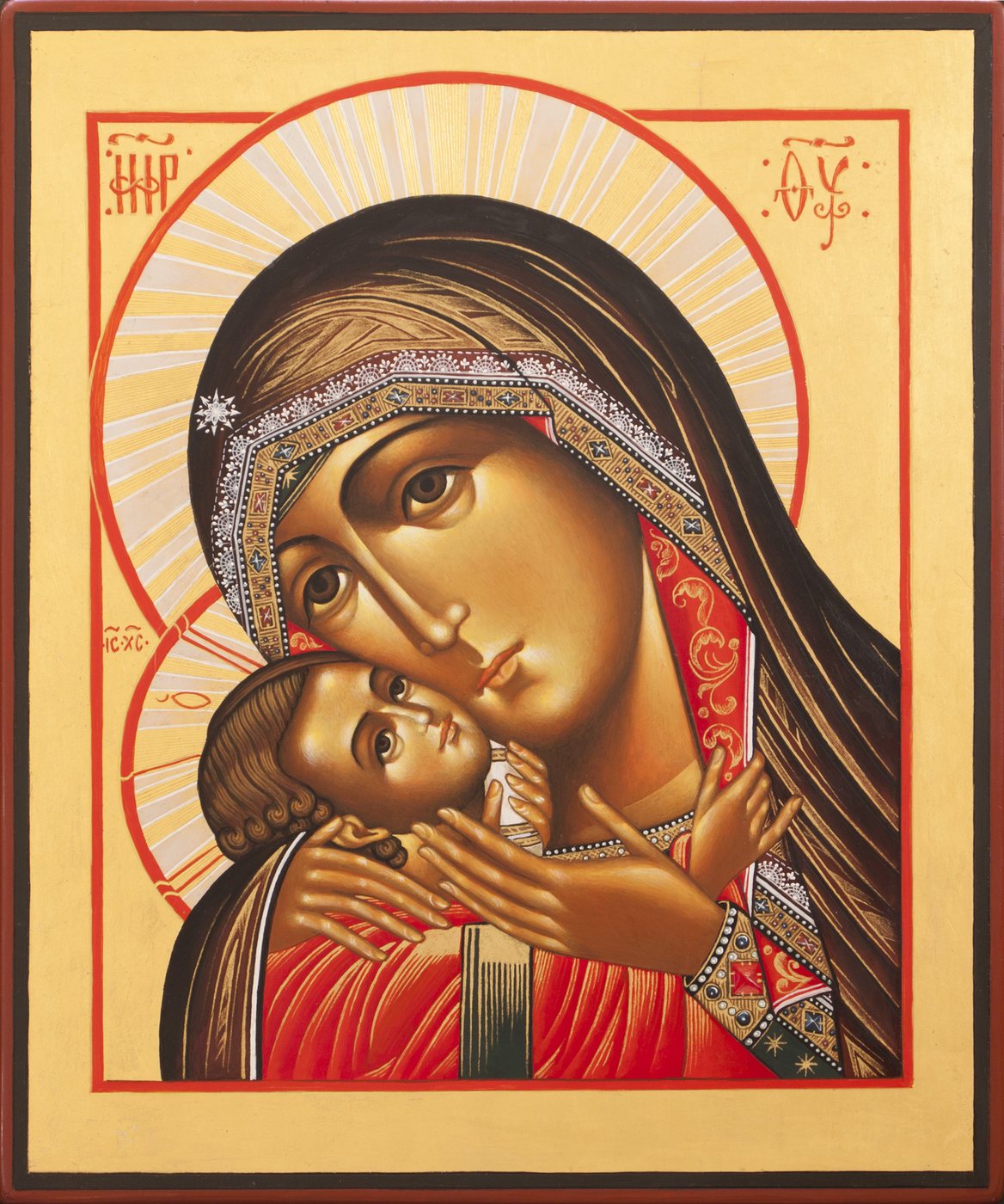
Theotokos of Korsun
Eleousa, radiant halos, MP ΘY and IC XC monograms.
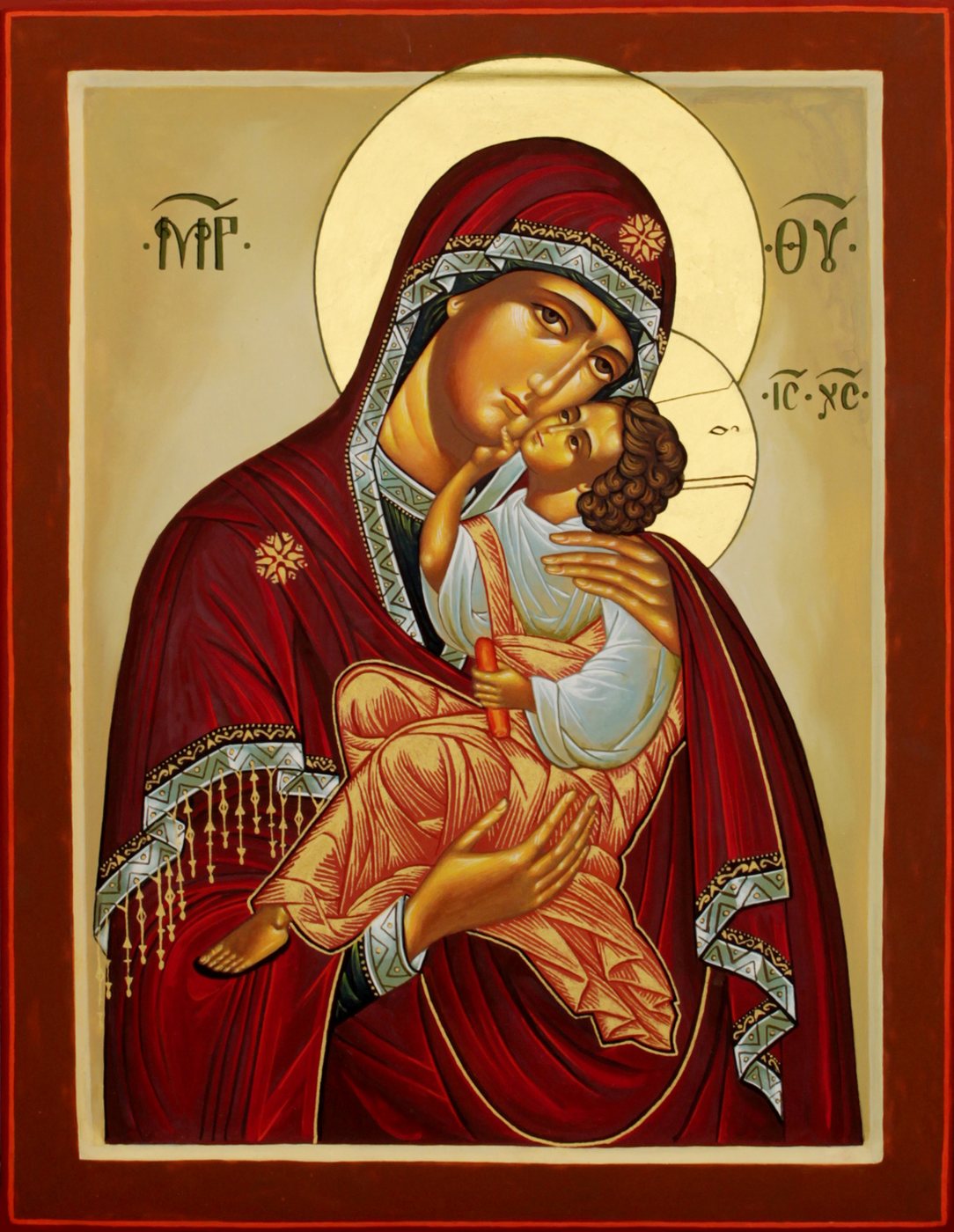
Virgin of Tenderness
Red mantle with decorated fringes, the Child holding a scroll.
Frequently asked questions
What is the difference between the Virgin of Vladimir and the Virgin of Tenderness?
Tenderness (Eleousa) is the iconographic type; the Virgin of Vladimir is its most famous icon, from which many variants derive. Each icon of Tenderness, however, has its own details: the position of the Child, of the hands, of the foot.
When is the feast of the Virgin of Vladimir?
The main feast, on 26 August (8 September in the civil calendar), recalls the deliverance of Moscow from Tamerlane in 1395. The Russian Church also remembers two other occasions when the icon defended the city.
For which occasion is it given?
It is the traditional gift for a wedding and for the birth of a child: the embrace of Mother and Child is the very image of the love that protects.