The binder of light
Egg tempera in icons: what it is and why it lasts for centuries
An egg yolk, a little water and a handful of ground earth: with these humblest of materials the most precious icons of Christendom were painted. Egg tempera has been the technique of the panel icon for almost a thousand years, and it is still the one Concetta Basile uses for every work.
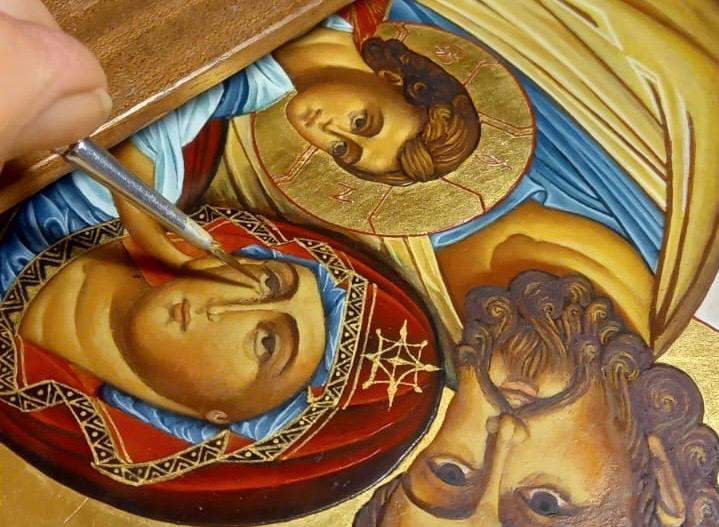
What egg tempera is
«Tempera» comes from the Latin temperare, to mix in the right measure. In egg tempera the powdered pigment, which on its own adheres to nothing, is bound with the yolk: the proteins and fats of the egg form a natural emulsion which, as it dries, encloses each grain of colour in a thin, strong and elastic film.
The oldest icons that have come down to us, the sixth-century icons of Saint Catherine's Monastery at Sinai, are painted in encaustic, with hot wax. In the following centuries egg tempera became the technique of the panel icon throughout the Byzantine world, and later of Italian gold-ground painting. At the beginning of the fifteenth century Cennino Cennini, in his Book of the Art, describes tempera painting on panel and the preparation of altarpieces; only during the fifteenth century would oil painting spread in the West. The icon, however, remained faithful to the egg.
How it is prepared: yolk, water and pigment
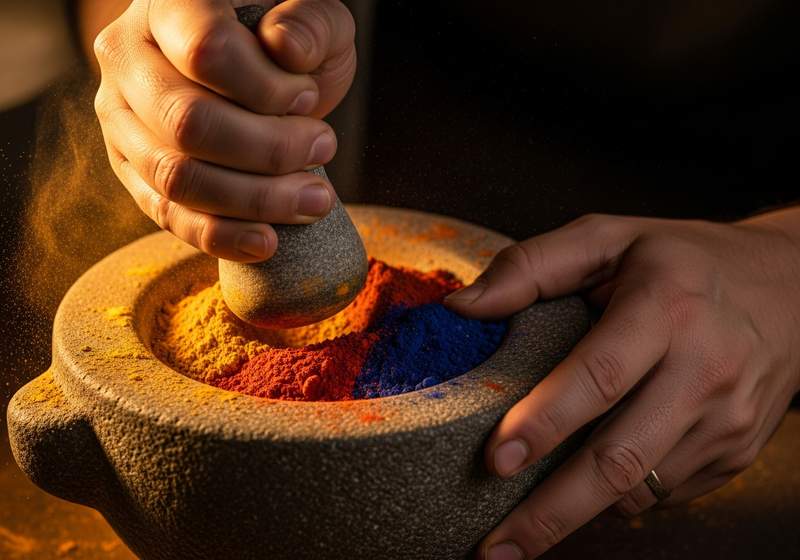
Traditionally the yolk is separated from the white and freed from its membrane, then diluted with water; many iconographers add a few drops of white wine or vinegar, which help preserve the emulsion. The pigment, already finely ground, is worked into this binder on the palette a little at a time, because tempera dries in a few minutes.
Concetta Basile uses ochres, earths and oxides, ground by hand in the mortar and bound with egg yolk: the palette of the earth, through which the mineral kingdom joins the wood of the panel and the egg, sign of life. Nothing synthetic enters the colour.
How it is applied: from dark to light
Egg tempera is not laid on thickly: it is worked in glazes, very thin, almost transparent washes, one over another. One begins with the darkest tone, the base of faces and garments (sankir in the Russian tradition, proplasmos in the Greek), then each new glaze adds a little light. This is the method tradition calls «illumination»: the image is not modelled with shadows but brought out of night towards day.
Finally come the highlights, the lightest touches on faces and garments: the Taboric light, which does not come from a window but from within the transfigured person. Dozens of glazes may be layered on a face: this too is why an authentic icon takes months.
Why egg tempera lasts for centuries
- It is touch-dry in minutes, but the film keeps consolidating for months: this is why the finished icon rests before the final varnish.
- Once consolidated, the egg film no longer dissolves in water and is highly resistant to yellowing.
- Thin glazes stay luminous: light passes through the layers and returns from the white gesso beneath, as from a mirror.
- Protected by the olifa, the cooked linseed oil varnish, tempera has crossed the centuries: medieval icons kept in museums and churches prove it.
Egg tempera, acrylic, oil, print: the differences
Egg tempera
Natural pigments bound with yolk, on a gessoed panel. Thin glazes, a silky, luminous surface, durability over centuries. It is the traditional technique of the icon.
Acrylic colours
Synthetic resins available since the mid-twentieth century. Quicker and simpler to use, often on supports without a gesso ground: an acrylic icon can be hand-painted, but not in the traditional technique.
Oil painting
It spread in the West from the fifteenth century: full-bodied colours, blending, shadows. It gave masterpieces to sacred painting, but it does not belong to icon technique.
Screen print and print
Images reproduced mechanically on wood, canvas or paper, sometimes retouched by hand or with gold glitter. They are not hand-painted icons.
How to recognise an egg tempera icon
Look at the surface under raking light: egg tempera has a silky, not plastic, sheen and reveals the layering of glazes and the fine strokes of the highlights, never thick brushwork. The colours lack the uniform saturation of acrylic and the dot pattern of print. The back of the panel, the gesso edges and documentation of the stages complete the picture: see our guide «Hand-painted or printed icon?». Like every icon by Concetta Basile, it is fully gilded with 23¾ karat gold, with inscriptions in Greek or Latin, and is commissioned with an offering proportionate to the time and materials of the work.
Frequently asked questions
Does egg colour spoil or smell over time?
No. Once dry and consolidated, tempera has no smell and does not alter: medieval icons painted with this technique prove it. What damages it is excessive humidity, direct heat and soot from candles placed too close: this is why there is a guide to caring for icons.
Why do icons use the yolk and not the white?
Because the yolk, thanks to its fats and proteins, forms an elastic film that follows the small movements of the panel without cracking. The white, more brittle, is used traditionally for other purposes, for example in some stages of gilding.
Is an acrylic icon a real icon?
It can be a devotional image painted by hand with respect. But the traditional technique of the icon, that of natural materials offered to God, is egg tempera on a gessoed panel with gold leaf: it is the one Concetta Basile follows in every work.
How many glazes does a face need?
There is no fixed number: it depends on the size, the subject and the finish. In the finest icons the glazes on a face number in the dozens, each applied only when the previous one is dry.