Nigra sum sed formosa
Our Lady of Tindari: history, miracles and a hand-painted icon
On the headland of Tindari, high above the sea between Patti and Oliveri in Sicily, the Dark Madonna has watched over the island for centuries. «Nigra sum sed formosa», I am dark but beautiful: the words of the Song of Songs carved at the foot of the statue speak of a beauty that goes beyond appearances.
The tradition: a ship fleeing the iconoclasts
According to the tradition kept by the Sanctuary, a ship returning from the East carried an image of the Madonna hidden in its hold, to save it from the iconoclast persecution. Caught by a storm in the Tyrrhenian Sea, the ship took refuge in the bay of Tindari, today's Marinello. When the sea calmed, the sailors could no longer make it move: they lightened the cargo, and only when they unloaded the chest with the statue of the Virgin could the ship sail on.
The local people opened the chest and decided to carry the image to the highest and most beautiful place, the hill of Tindari, where a Christian community already existed. The Sanctuary places its arrival towards the end of the eighth century or in the first decades of the ninth: Tindari was Byzantine for about three centuries (535-836), a bishop's see, and Sicily strongly resisted the iconoclast heresy.
The miracle of the child and the Marinello lagoons
The best-loved story tells of a mother whose gravely ill daughter had been healed. Arriving at the sanctuary to give thanks, she was disappointed by the Madonna's dark face: «I came from far away to see someone uglier than me». As she walked away, the child, left alone, fell from the top of the hill.
The mother returned to pray: «If you are the miraculous Virgin who saved my daughter the first time, save her a second time». The child was found playing peacefully on a small strip of sand that had suddenly formed in the sea below; a sailor brought her back safe and sound to her mother, who exclaimed: «Truly you are the great miraculous Virgin». Still today, at the foot of the headland, the sand spits of the Marinello lagoons recall that day.
From the old sanctuary to the basilica
The oldest church was destroyed in 1544; the rebuilt sanctuary, whose portal bears the date 1598, is still preserved beside the new church. To welcome the ever-growing pilgrimages, Bishop Giuseppe Pullano of Patti promoted a new church: the foundation stone, taken from the Greco-Roman ruins of Tindari and blessed by Pius XII, was laid on 8 December 1957.
On 6 September 1975 the statue of the Madonna was carried into the new sanctuary, opened to the faithful on 8 September, the feast of the Nativity of Mary. On 1 May 1979 Cardinal Salvatore Pappalardo consecrated it together with all the bishops of Sicily. Today it is a minor basilica: behind the altar four bronze angels hold up the Virgin's throne, and from the great loggia one looks down on the Marinello lagoons.
John Paul II before Our Lady of Tindari
On the morning of 12 June 1988, as a pilgrim to the sanctuary, John Paul II prayed before the statue, entrusting to Our Lady of Tindari the Church that invokes her as Mother, and asking her to comfort her devoted people in their difficulties and trials.
In the same prayer the Pope entrusted the Church of Patti to the Virgin and asked that the new generations of «this wonderful island» might meet Christ, the way, the truth and the life.
The statue and its restoration: a Madonna with open eyes
Our Lady of Tindari is a cedar-wood statue in Byzantine style: the Virgin sits enthroned and holds on her lap the Child, who raises his right hand in blessing; on her head she wears an Eastern-style crown, like a turban, carved from the same wood. In her right hand she holds a lily. On the base is carved «Nigra sum sed formosa»: a verse of the Song of Songs which, the Sanctuary explains, expresses Mary's beauty in the dark colour of her face.
The restoration begun in 1995 freed the statue from centuries of overpainting: beneath the fabric robes a wooden panel carved with false folds reappeared, painted with a blue at least from the fourteenth century, and the eyes, hidden under layers of paint and smoke, turned out to be open, drawn in a Middle Eastern manner.
How to read the icon
- The enthroned Virgin is the Seat of Wisdom: her lap is the throne of the Son of God.
- The Child blesses with his right hand and looks at the one who prays, as in icons of the Hodegetria.
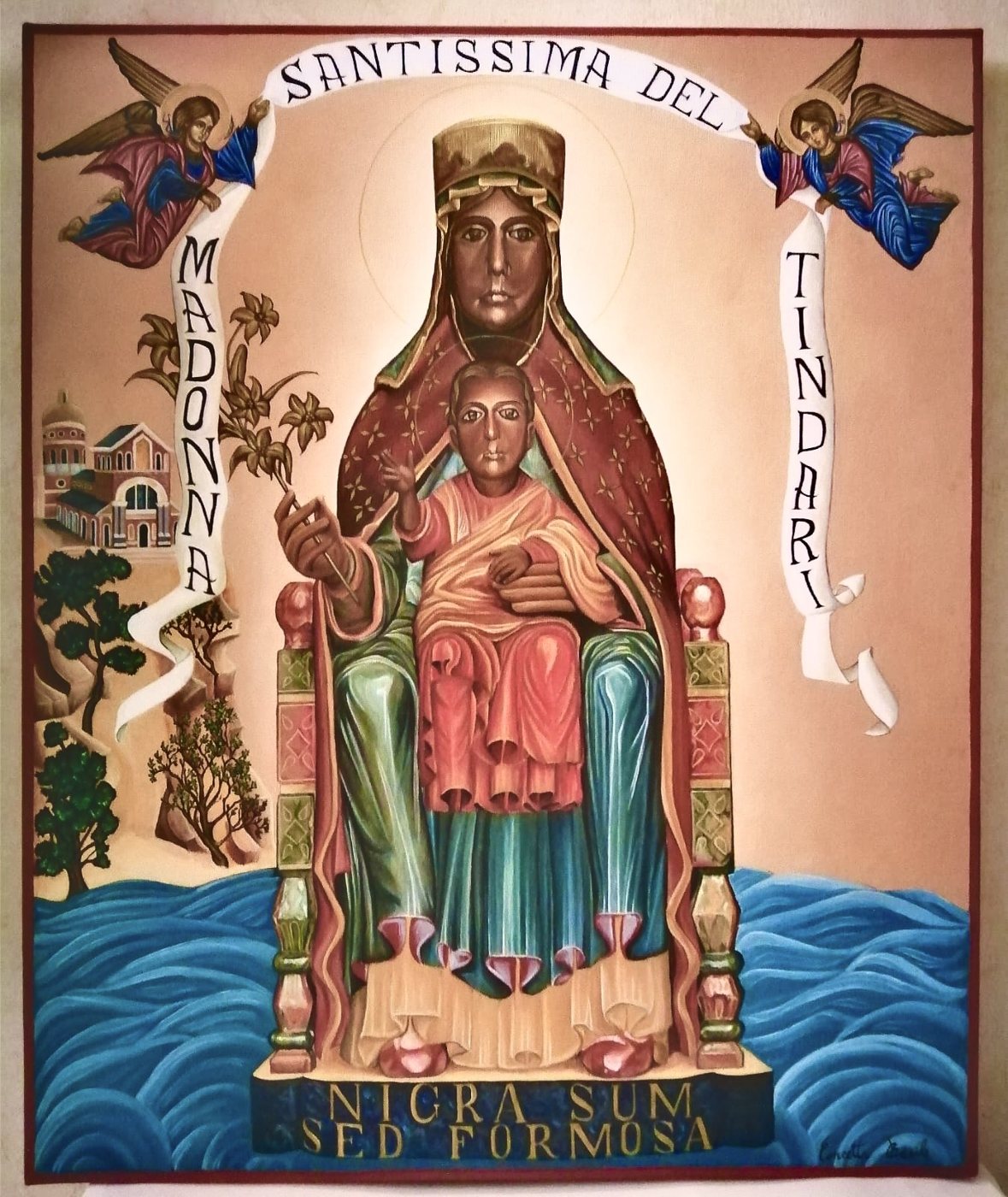
- The dark face recalls the Song of Songs: «Nigra sum sed formosa», I am dark but beautiful.
- The lily in the Mother's hand is the sign of her purity.
- The sea and the headland with the sanctuary recall the ship of the tradition and the miracle of Marinello.
- Angels in flight hold the scroll with the Madonna's name, as in icons of Marian shrines.
Concetta Basile's Our Lady of Tindari
Concetta Basile, a Sicilian iconographer, has translated the statue of Tindari into the language of the icon. The Mother of God sits on a decorated throne, with the Eastern crown and the red mantle strewn with stars, the lily in her right hand and the blessing Child on her lap. Two angels in flight hold the scroll with the Madonna's title; on the left, the sanctuary on the headland among the trees of the coast; at the foot of the throne the waves of the sea and, on the base, the Latin inscription «Nigra sum sed formosa».
An icon of Our Lady of Tindari is a gift that speaks of Sicily and of coming home: for those who live far from the island, for a family devoted to the Dark Madonna, for a pilgrimage to remember. Like every work by Concetta Basile, it is commissioned with an offering proportionate to the time and materials of the work.
Our Lady of Tindari
The Dark Virgin enthroned with the Child and the lily, the angels with the scroll, the sanctuary on the headland and the sea; «Nigra sum sed formosa».
Frequently asked questions
When is the feast of Our Lady of Tindari?
The solemnity of Mary Most Holy of Tindari is celebrated on 7 and 8 September, on the feast of the Nativity of Mary: thousands of pilgrims climb to the sanctuary, many on foot, from all over Sicily.
Why is Our Lady of Tindari dark?
The statue has a dark face, like other Black Madonnas of Europe. The inscription on the base, «Nigra sum sed formosa» (Song of Songs 1:5), gives its spiritual reading: Mary's beauty in the dark colour of her face. The story of the disappointed mother and the rescued child teaches not to stop at appearances.
Where is the sanctuary?
On the headland of Tindari, in the municipality of Patti, province of Messina, Sicily, beside the excavations of ancient Tyndaris and above the Marinello lagoons nature reserve. The old sanctuary is preserved next to the basilica.
Can I commission a hand-painted icon of Our Lady of Tindari?
Yes. Concetta Basile paints Our Lady of Tindari entirely by hand, also in custom sizes and details, with inscriptions in Latin or Greek.