From A to Z
Iconography glossary
The words of the icon come from Greek, Russian and Latin. This glossary gathers the essential terms of technique, theology and tradition, for those who wish to commission an icon, study it or simply understand it better.
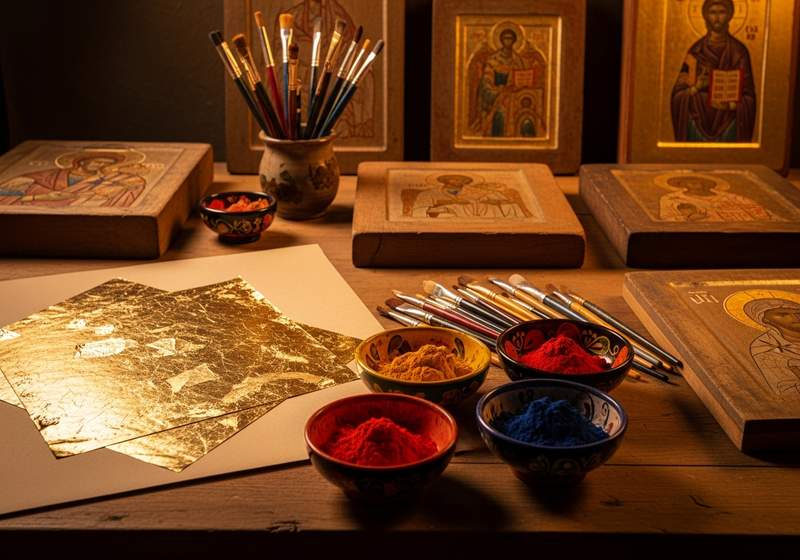
Technique and materials
Panel
The seasoned wooden support on which the icon is painted.
Recess (kovcheg)
The slightly recessed central field, surrounded by a raised border: it separates sacred space from the world.
Pavoloka
The cloth glued to the panel before the gesso, protecting it from the movements of the wood.
Levkas
The ground of gesso (or calcium carbonate) and animal glue, laid in many coats and polished.
Bole
Very fine clay, red or yellow, on which gold leaf is laid for water gilding.
Mordant gilding
Gilding with an adhesive (mordant) onto which the gold leaf is applied.
Egg tempera
The traditional binder of the icon: egg yolk, water and a little vinegar or wine, mixed with pigments.
Sankir
The dark base colour of faces and hands, on which light is built.
Highlights
The ever lighter layers that bring the figures from shadow into light.
Assist
The fine gold lines on the garments of Christ, the Mother of God and the angels: divine light passing through them.
Olifa
The final varnish based on boiled linseed oil, which protects and enlivens the colours.
Podlinnik / Hermeneia
The iconographers' manuals: drawn patterns (podlinnik, in Russian) and treatises such as the Hermeneia of Dionysius of Fourna (18th century).
Types and compositions
Pantocrator
«Ruler of all»: Christ blessing, with the Gospel.
Mandylion
The face of Christ imprinted on cloth, the Holy Face «not made by human hands».
Hodegetria
The Mother of God pointing to her Son, «she who shows the Way».
Eleousa
The Mother of God of Tenderness, cheek to cheek with the Child.
Platytera
The Mother of God of the Sign, praying, with Emmanuel on her breast.
Deesis
Christ between the interceding Mother of God and Saint John the Baptist.
Dodekaorton
The twelve great feasts of the liturgical year.
Anastasis
The Easter icon of Christ's Descent into Hades.
Garments, space and liturgy
Halo (nimbus)
The golden ring around the heads of saints; Christ's carries the cross and the letters Ο ΩΝ.
Mandorla
The oval of light, in concentric bands, surrounding Christ in glory.
Clipeus
The circular medallion containing a figure, like Emmanuel in the Platytera.
Maphorion
The purple mantle of the Mother of God, covering her head and shoulders.
Chiton and himation
The tunic and cloak of Christ and the apostles.
Omophorion
The broad stole with crosses worn by bishops, such as Saint Nicholas.
Inverse perspective
Lines that open towards the viewer instead of converging on the horizon.
Iconostasis
The wall of icons separating the sanctuary from the nave in Byzantine-rite churches.
Titlo
The mark above letters indicating an abbreviation, as in IC XC.
Riza (oklad)
A metal cover leaving only faces and hands visible; Concetta Basile's icons are fully painted and gilded, without a riza.