Protectress of Russia
Our Lady of Kazan: history, miracles and a hand-painted icon
A little girl, a fire, an icon found beneath the ruins: this is how, in 1579, the story of the Mother of God of Kazan begins, the most venerated icon of the Russian people. An ancient copy of it watched over Saint John Paul II's prayer for more than ten years, until in 2004 he returned it to Russia as a sign of unity among Christians.
The finding: Kazan, 1579
In the summer of 1579 a great fire destroyed much of the city of Kazan, on the Volga. According to the traditional account, the Mother of God appeared in a dream to a girl of about ten, Matrona, showing her the place where an icon lay buried in the ruins of a house, once hidden to keep it from the enemies of the faith. After the dream was repeated, on 8 July 1579 the girl and her mother dug and found it intact, wrapped in a cloth, its colours as bright as if freshly painted.
Among the first to carry it in procession was a priest of the church of Saint Nicholas, Hermogenes, who would later become Metropolitan of Kazan and Patriarch of Moscow. It was he who, in 1594, wrote down the Tale of the appearance of the icon and of the miracles that followed: healings of the blind and the sick, remembered by the Russian Church on the feast of 8 July (21 July in the civil calendar).
The miracle of 1612 and the liberation of Moscow
In the «Time of Troubles» Moscow was occupied by foreign troops. Patriarch Hermogenes, a prisoner, urged the people to prayer and fasting; a copy of the Kazan icon was entrusted to the militia led by Prince Dmitry Pozharsky and the merchant Kuzma Minin. In the autumn of 1612 Moscow was liberated, and Pozharsky attributed the victory to the intercession of the Mother of God.
In thanksgiving the Cathedral of Our Lady of Kazan was built on Red Square, and the feast of 22 October (4 November in the civil calendar) entered the calendar of all Russia. Later, in Saint Petersburg, the great Kazan Cathedral on Nevsky Prospect kept another of the most venerated copies.
The Kazan icon and John Paul II
The original Kazan icon was stolen in 1904 and has never been found. After the 1917 revolution some ancient copies left Russia; one of them, after a long stay at the Shrine of Fatima, came to the Vatican and was placed in the Pope's apartment.
At the general audience of 25 August 2004 John Paul II said that this icon had accompanied his daily service to the Church with a motherly gaze, and that he had always wished it to return to the soil of Russia, where it had been venerated for centuries. A delegation led by Cardinal Walter Kasper handed it over in Moscow to Patriarch Alexy II. In his letter to the Patriarch the Pope called it «one of the symbols of the unity of the disciples of the only-begotten Son of God».
How to read the icon
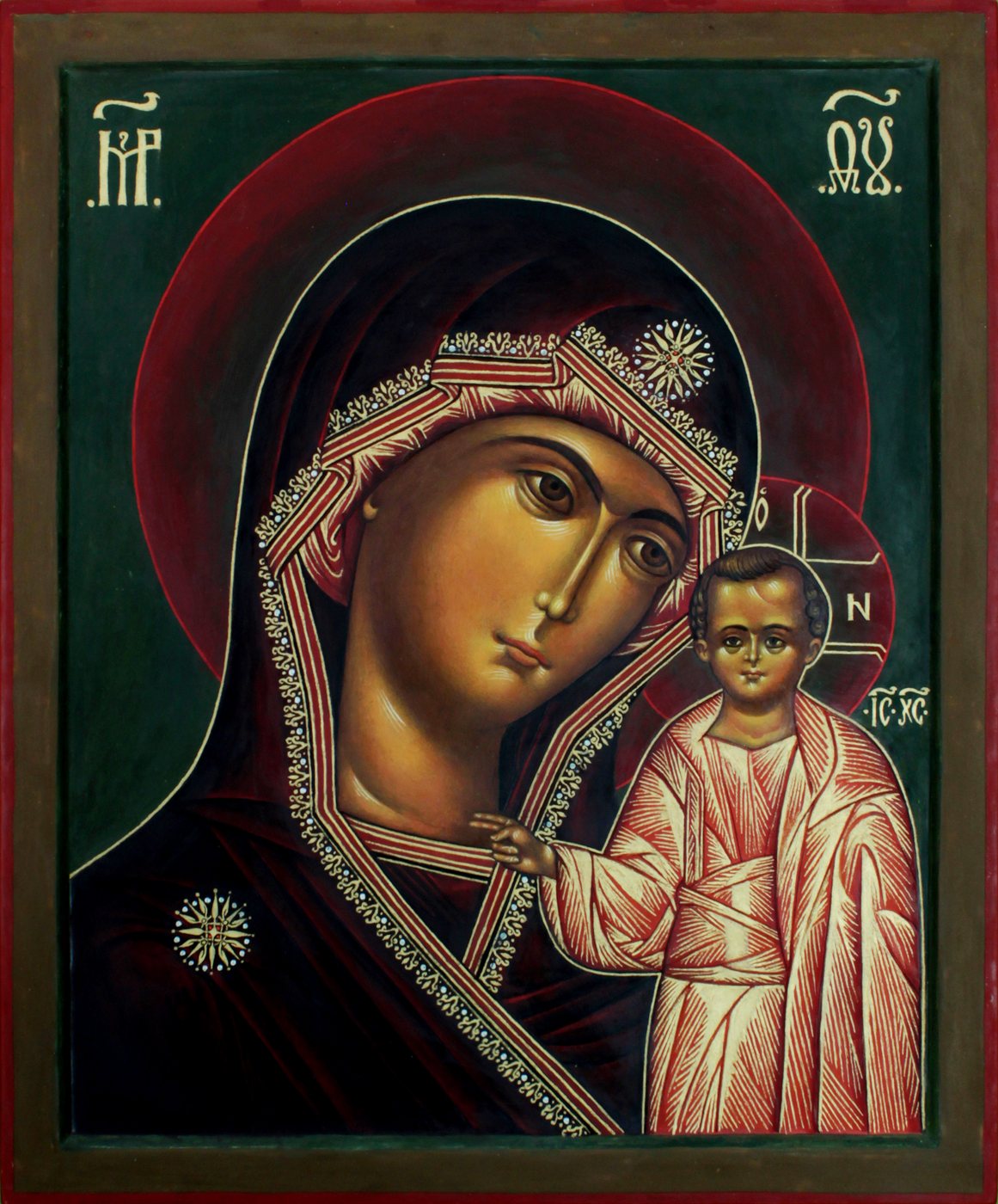
- It is a variant of the Hodegetria, «she who shows the way»: the Mother presents her Son to those who pray.
- The Child stands upright, facing forward, blessing with his right hand; often the Mother's hands are not visible.
- Mary's head is slightly inclined towards her Son: proclamation becomes tenderness.
- In Christ's halo the letters Ο ΩΝ, «He who is»; at the sides the monograms MP ΘY and IC XC.
- The three stars on the purple mantle recall Mary's virginity before, during and after giving birth.
- The ancient icon was small: an image to carry, to keep at home, to bear in procession.
Concetta Basile's Kazan icon
In the Our Lady of Kazan painted by Concetta Basile the dark green ground sets off the red halo and the light of the face; the Mother's mantle is edged with a gold border with pearls, and the Child's garments are crossed by dense highlights, like rays. It is painted in egg tempera with natural ochres, earths and oxides, on a gessoed panel. Like every icon by Concetta Basile, it is fully gilded with 23¾ karat gold, with inscriptions in Greek or Latin, and is commissioned with an offering proportionate to the time and materials of the work.
Our Lady of Kazan
Hodegetria type, green ground, red halo, MP ΘY and IC XC monograms.
Frequently asked questions
When is the feast of Our Lady of Kazan?
The Russian Church celebrates it on 8 July (21 July), in memory of the finding of 1579, and on 22 October (4 November), in memory of the liberation of Moscow in 1612. The dates in brackets are those of the civil calendar.
Where is the original Kazan icon today?
The original was stolen in 1904 from the Kazan Monastery of the Mother of God and has never been found. Ancient copies are venerated, including the one kept by John Paul II and returned to Russia in 2004.
Is Our Lady of Kazan a good gift for an Orthodox family?
It is among the most loved icons in Russian and Orthodox homes, and is traditionally given to newly-weds. For a Catholic family it is also a sign of communion between East and West, in memory of John Paul II's gesture.