The invisible foundation
The icon panel: wood, linen and gesso, layer by layer
In an icon we look at the face and the gold, but its durability is decided earlier, in a stage no one sees once the work is finished: the preparation of the panel. Weeks of patient work, coat after coat, to obtain a white surface as smooth as ivory, able to hold the colours for centuries.
The wood
The traditional support is a panel of solid wood, well seasoned so that it does not move. In ancient Russia the most common wood was linden (lime); in Italy, at the beginning of the fifteenth century, Cennino Cennini recommends for altarpieces «whitewood» (poplar), linden or willow. They are soft, even, low-resin woods that take glue and gesso well.
Wood is alive: with humidity and temperature it expands and contracts. This is why old solid-wood panels, especially large ones, had dovetailed battens set into the back (shponki in Russian) that restrain warping without locking the wood entirely.
Concetta Basile paints on linden multi-ply panels: the same wood as Russian icons, but made of thin sheets laid with their grain crossed. This structure neutralises the movement of the wood, so the panel does not warp or split with changes in humidity and needs no battens. On this stable support the gesso ground, the gold and the glazes stay intact over time.
The recess: the sacred space
The central field of the panel is slightly lowered, leaving a raised border around it. This recess, called kovcheg, «ark», in Russian, separates the space of the image from the world: as the Ark of the Covenant held the presence of God, so the field of the icon holds the presence of the saint. There are also icons painted on flat panels, equally traditional; every panel by Concetta Basile, however, has the recess with its raised border.
The linen
Before the gesso, a cloth (pavoloka in Russian) is traditionally glued to the face of the panel. Cennini recommends old, thin linen, without a trace of grease. The cloth binds the gesso to the wood, softens the movement of the fibres and reduces the risk that, over the years, the joints of the panel transmit themselves to the painting as cracks. Concetta Basile always glues linen to her panels before applying the gesso.
Gesso and rabbit-skin glue
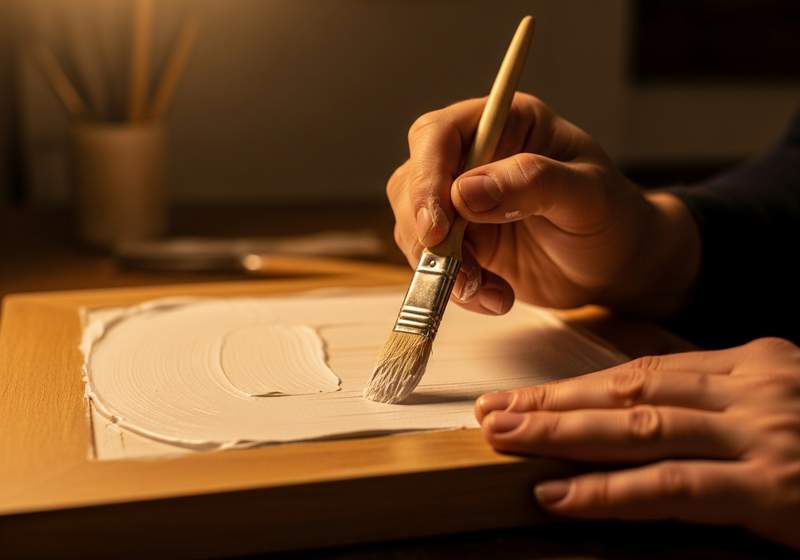
The white ground of the icon, called levkas in the Russian tradition, is a mixture of very fine gesso or chalk and animal glue, traditionally rabbit-skin glue, melted in a bain-marie. It is applied warm, by brush, one coat after another: each coat must dry before the next. Cennini, for his ground of fine gesso, prescribes «at least eight» coats on flat surfaces.
In museum-grade finishes Concetta Basile exceeds ten coats of gesso. The thicker and more even the ground, the cleaner the incision of the drawing, the brighter the gold and the more stable the painting over time.
Sanding by hand
When the gesso is dry and consolidated, the surface is sanded by hand, patiently, until it is as smooth as ivory. It is a slow and silent stage: tradition compares it to the first day of Creation, when the earth was still formless and the Lord began to give it shape. On this surface, with an engraving tool, the lines of the drawing will then be traced.
Why the panel tells you whether an icon is authentic
- The back: an authentic panel is real wood, solid or linden multi-ply, carefully finished; a chipboard or MDF board with a print glued on, or a plastic support, point to series production.
- The edges: in the recess and at the margins of the panel, gesso laid in many coats shows as a compact white thickness.
- The surface: under raking light the gesso ground is perfectly smooth and the incised lines of the drawing can be felt beneath the colours.
- Documentation: every icon by Concetta Basile comes with photographs of every stage, from the bare panel to the final varnish, with the time recorded.
Frequently asked questions
Is an icon on multi-ply less valuable than one on solid wood?
No: what decides quality and durability is the preparation. Linden multi-ply is more stable than solid wood, because the crossed grain prevents warping and splitting; this is why many iconographers choose it today. What matters is that the panel receives linen, gesso with animal glue in many coats, real gold and egg tempera. Many commercial icons, by contrast, are prints glued to MDF or chipboard with no preparation at all.
Why are so many coats of gesso needed?
Because each coat must be thin to dry without cracking, but the ground as a whole must be thick enough to take the incision, the gilding and dozens of glazes of colour. Museum-grade finishes exceed ten coats.
Is the gesso of an icon sensitive to humidity?
Yes: gesso with animal glue is sensitive to water and to swings in humidity until it is protected. This is why the finished icon is sealed with olifa, and should be placed away from heat sources and damp walls, as the guide to caring for icons explains.