Reading an icon
Icon symbolism: colours, gestures and light
In an icon nothing is decorative. Every colour, every gesture, every fold of a garment belongs to a language the Church developed over the centuries to speak of the Mystery. Learning its alphabet means learning to read an icon as one reads a text.
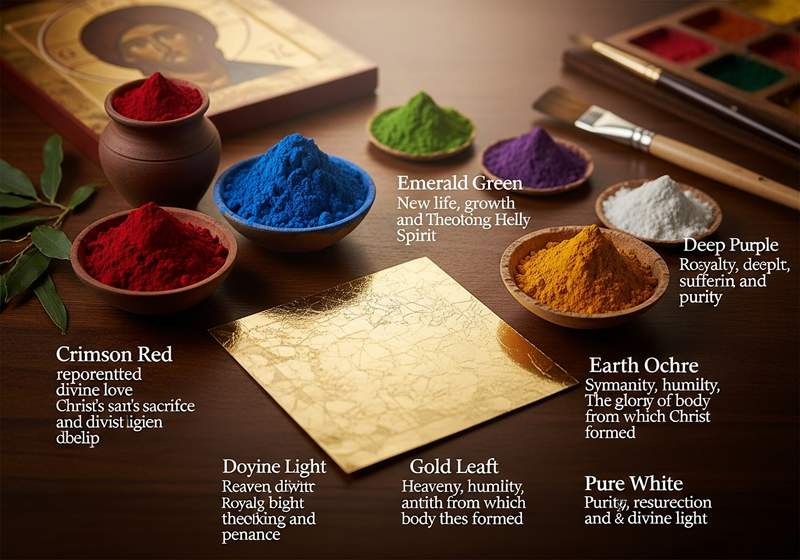
The meaning of colours
Gold
The uncreated light of God, eternity. It is not one colour among others: it is the light in which everything is immersed.
Red and purple
Life, love, the blood of the martyrs; purple is the colour of royalty and divinity.
Blue
Heaven, the depth of mystery and, in garments, humanity.
Green
Life reborn, creation; sometimes associated with the Holy Spirit.
White
The light of the Resurrection and the Transfiguration, the purity of the saints.
Black
The abyss, death, the darkness into which light descends: the caves of the Nativity and the Resurrection.
The garments of Christ and the Mother of God
Christ usually wears a red or purple tunic (divinity) and a blue mantle (the humanity he assumed). The Mother of God, conversely, wears a blue dress beneath a purple mantle, the maphorion: she is a human creature clothed with the divinity she carried in her womb. Three stars shine on her mantle, on the forehead and shoulders: her virginity before, during and after childbirth.
Gestures, space and light
- Christ's blessing hand: the fingers form the letters IC XC, or join three fingers (the Trinity) and two (the two natures).
- Inverse perspective: lines open towards the viewer, who thus stands at the centre of the sacred space.
- Light without shadows: figures are luminous from within, because transfigured.
- Buildings joined by a red cloth show that the scene takes place indoors; stepped mountains show a high place, of encounter with God.
- Facial proportions: large eyes, thin nose, small closed mouth, ears often hidden: purified senses turned towards the spirit.
Frequently asked questions
Why do icon figures look «flat»?
Because the icon does not seek to imitate the visible world but to show transfigured reality. The absence of volume and shadow is a theological choice, not a technical limitation.