The Mother of God
Hand-painted icons of the Mother of God: the iconographic types
No subject has been painted as often as the Mother of God. Tradition attributes her first images to the evangelist Luke, and from those prototypes many different «types» have arisen over the centuries: each shows one aspect of the mystery of Mary and her bond with her Son. Knowing them helps you choose the right icon for a home, a birth, a wedding, a church.
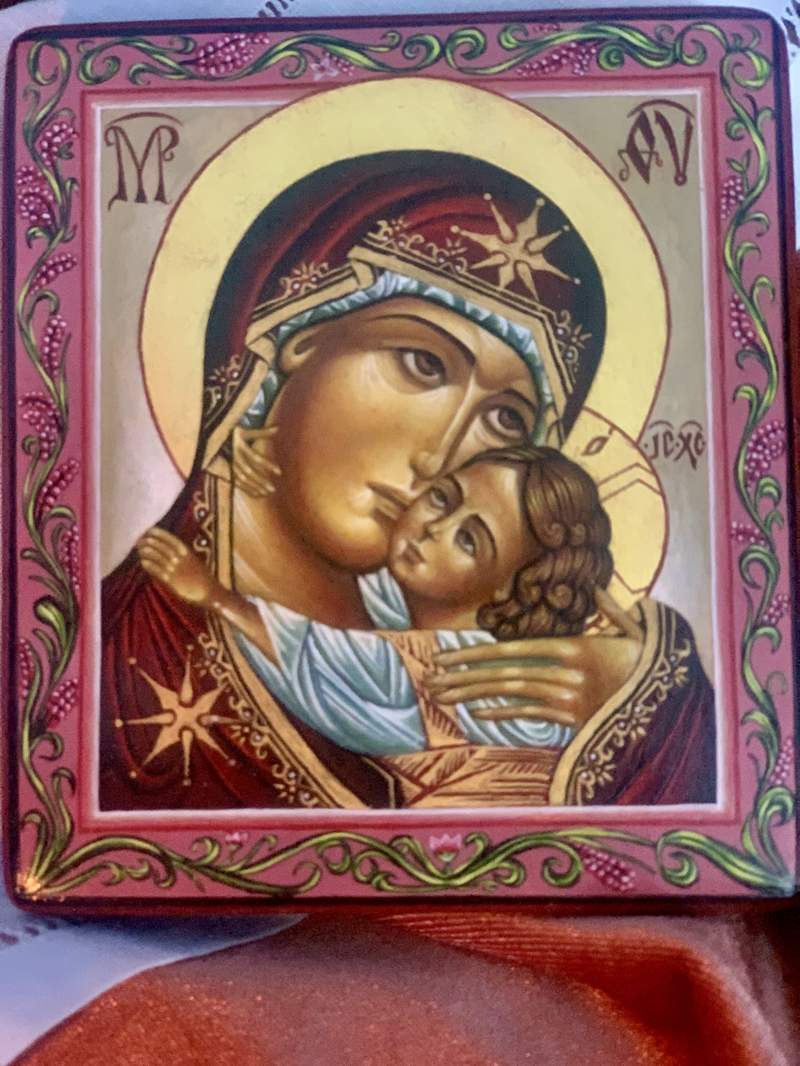
One Mother, many faces
In the icon Mary is never alone like a portrait figure: she is the Theotokos, the Mother of God proclaimed by the Council of Ephesus in 431, and she almost always holds or points to her Son. The inscriptions MP ΘY (Μήτηρ Θεοῦ, Mother of God) and IC XC say so in every icon. The purple-red mantle (maphorion) over the blue robe and the three stars on her forehead and shoulders, sign of her virginity before, during and after giving birth, make her recognisable in every type.
The great iconographic types
Hodegetria
«She who shows the way»: the Mother presents her Son with her right hand. It is the oldest and most widespread type; in Rome the Salus Populi Romani is linked to it.
Eleousa, Tenderness
The Child presses his cheek to his Mother's. The most famous model is the Theotokos of Vladimir. It is the icon par excellence of families and births.
Glykophilousa, Sweet Kiss
A variant of Tenderness in which the embrace is even closer: the Son clasps his Mother's neck. An ancient icon of this type is venerated on Mount Athos.
Platytera, the Sign
Mary in prayer with raised arms and Christ Emmanuel in a medallion on her breast: «wider than the heavens», because she contained Him whom the heavens cannot contain.
Perpetual Help
The archangels show the instruments of the Passion and the Child clings to his Mother, losing a sandal. It is the icon of consolation in trials.
Hagiosoritissa, the Advocate
Mary without the Child, in three-quarter view, with hands raised in intercession. In Rome, in the church of Santa Maria del Rosario on Monte Mario, one of the city's oldest Marian images of this type is kept.
Galaktotrophousa, the Nursing Mother
The Mother nurses her Son: the mystery of the Incarnation in the most human of gestures. In Italy it is much loved as the Madonna del Latte, protector of mothers.
Our Lady of Kazan
A Russian variant of the Hodegetria, found in Kazan in 1579: the Child upright and blessing beside his Mother's face. An ancient copy was kept by John Paul II until 2004.
The Mother of God enthroned
Mary sits in majesty with her Son on her knees, often between archangels: she is Queen of heaven, throne of Wisdom. Suited to churches and chapels.
Works by Concetta Basile
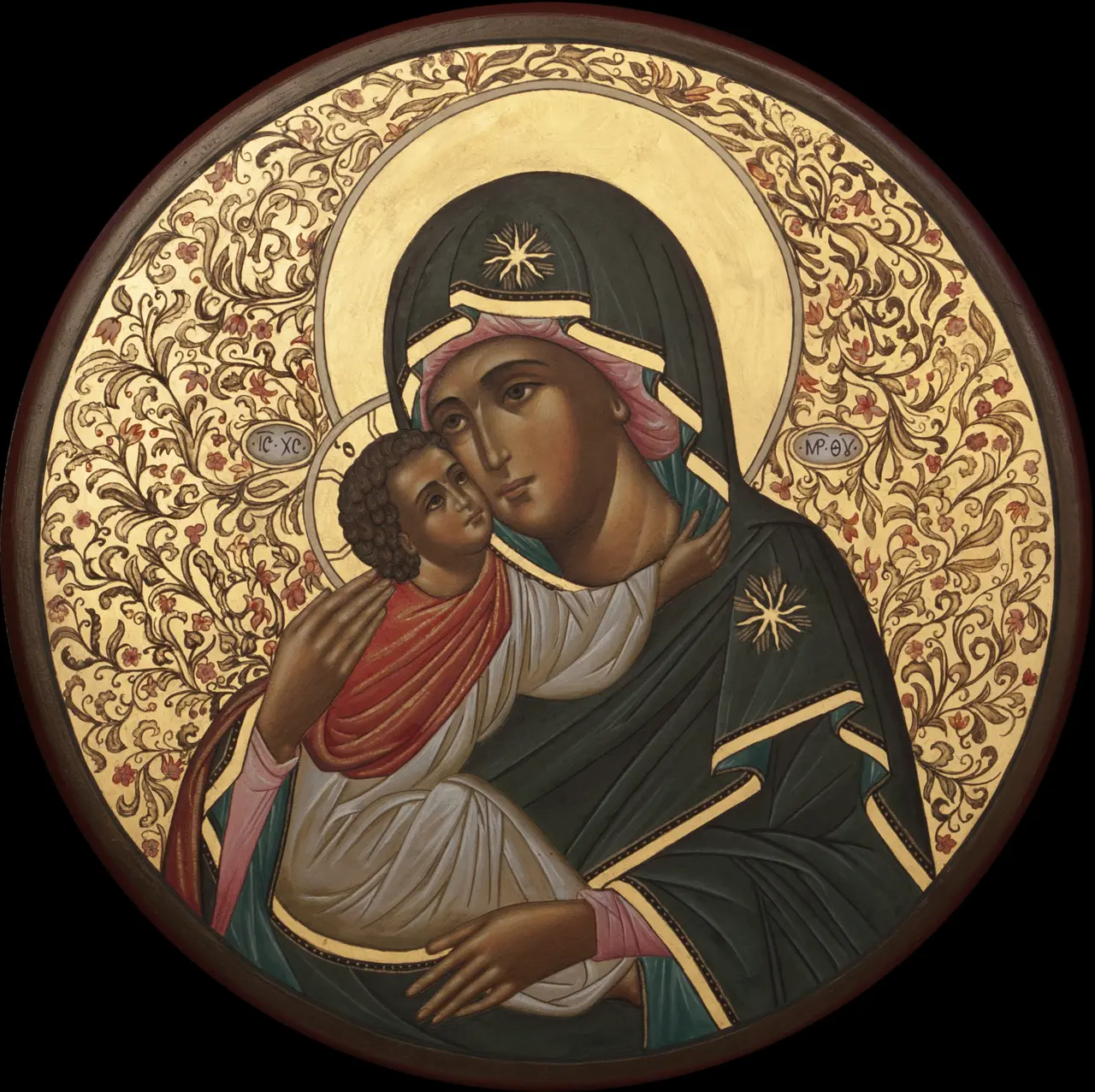
Mother of God of Tenderness
Eleousa type, rectangular panel, 23¾ karat gold.
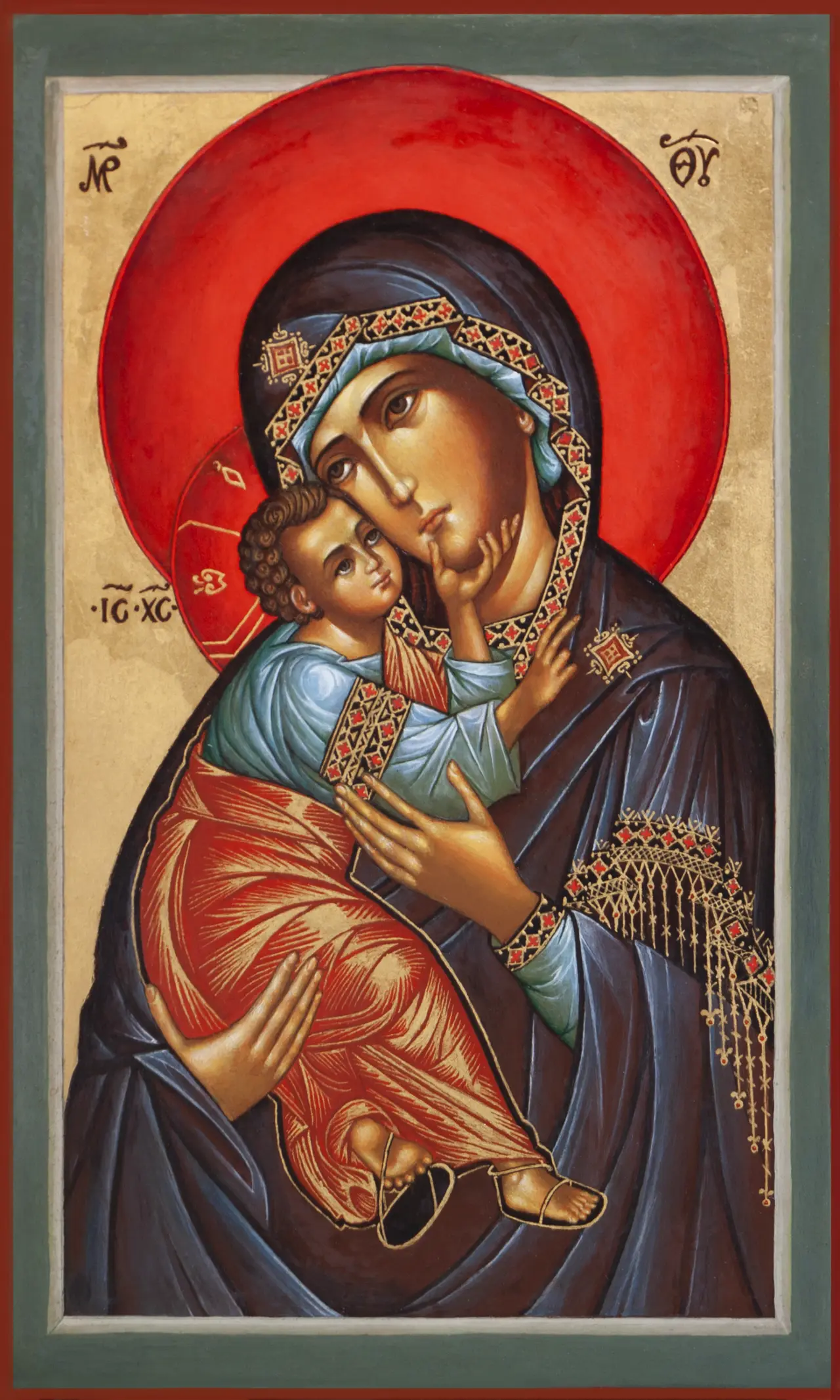
Madonna of the Martyrs
Tenderness type, red halo.
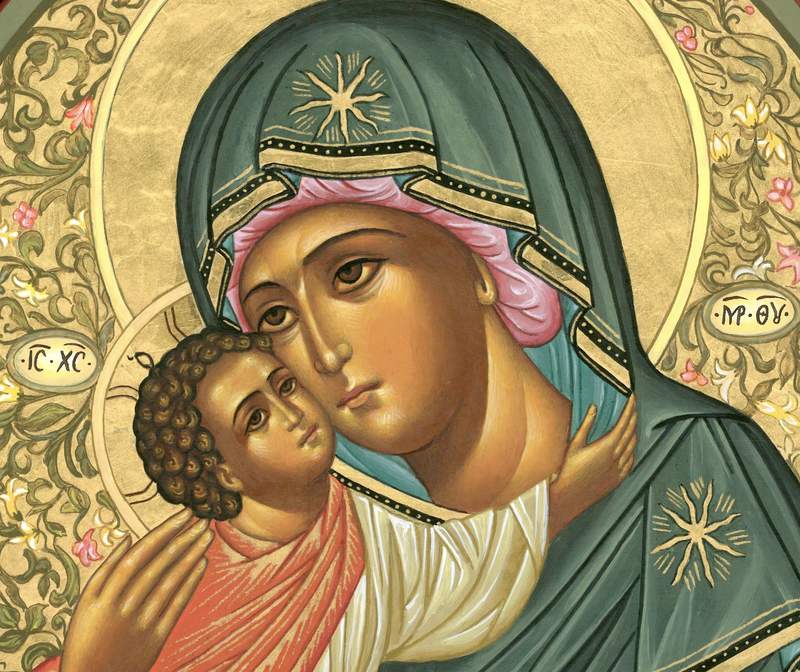
Mother of God of Tenderness
Detail of the face and gold ground.
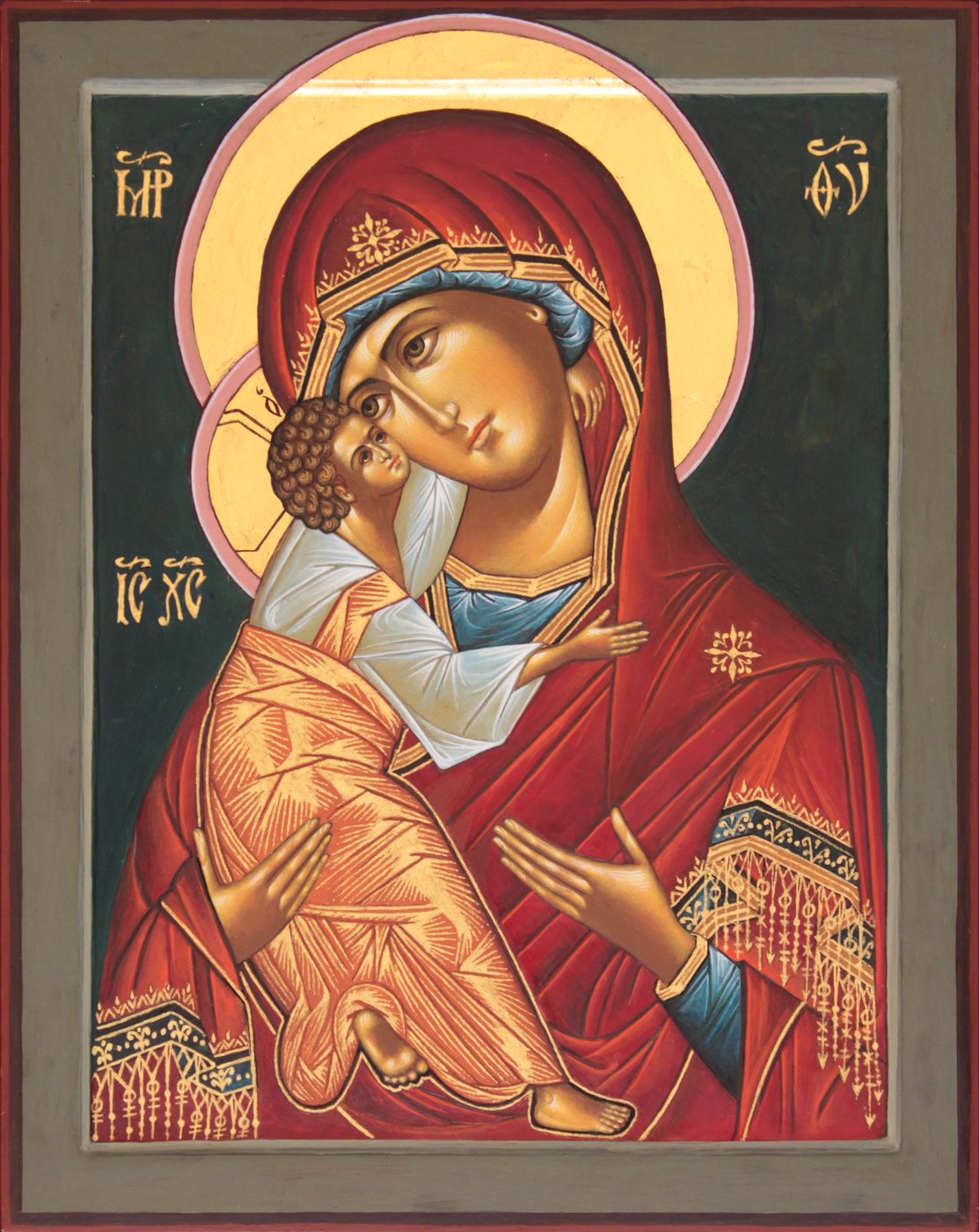
Theotokos of Vladimir
Eleousa, dark green ground.
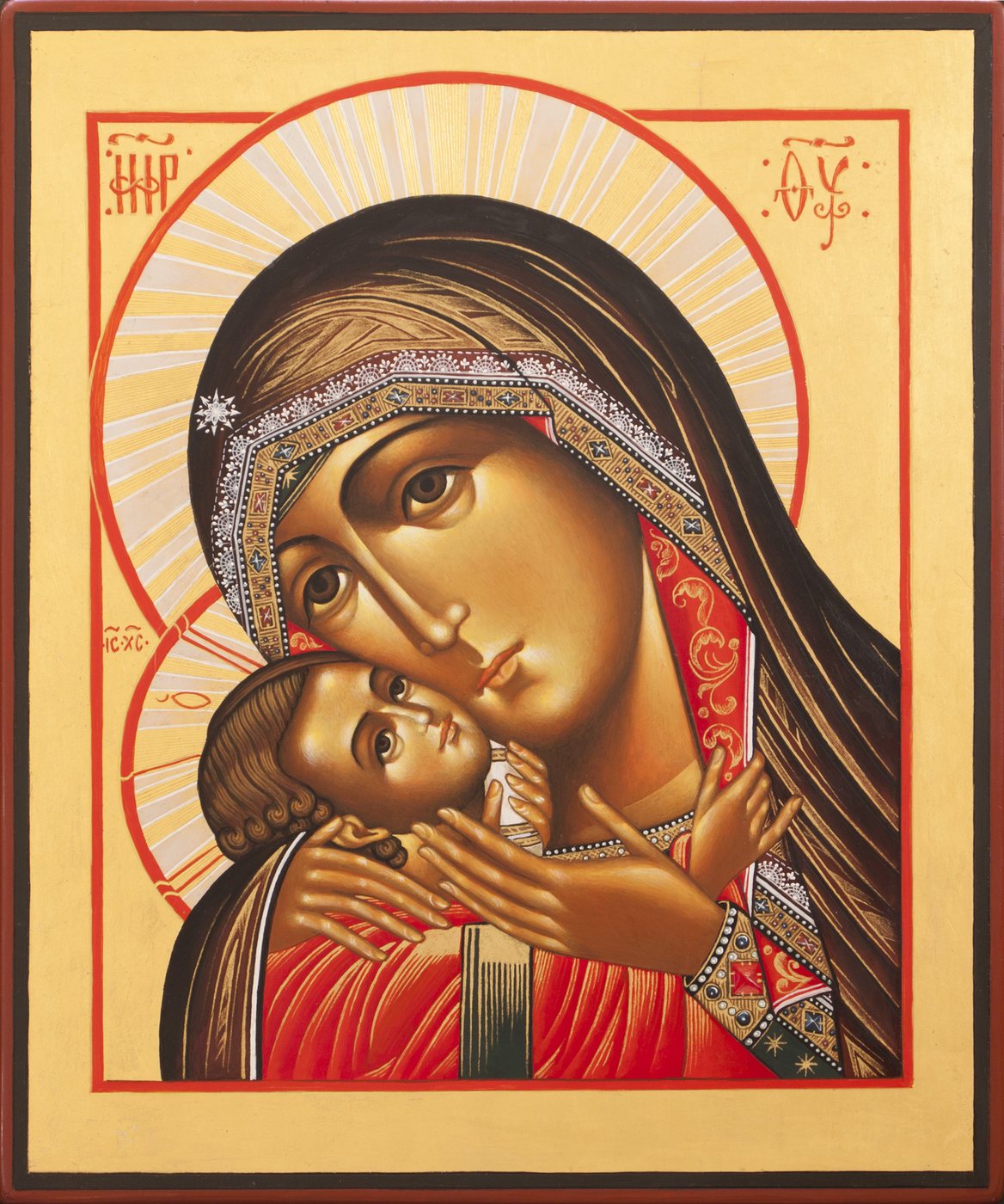
Theotokos of Korsun
Eleousa with radiant halos.
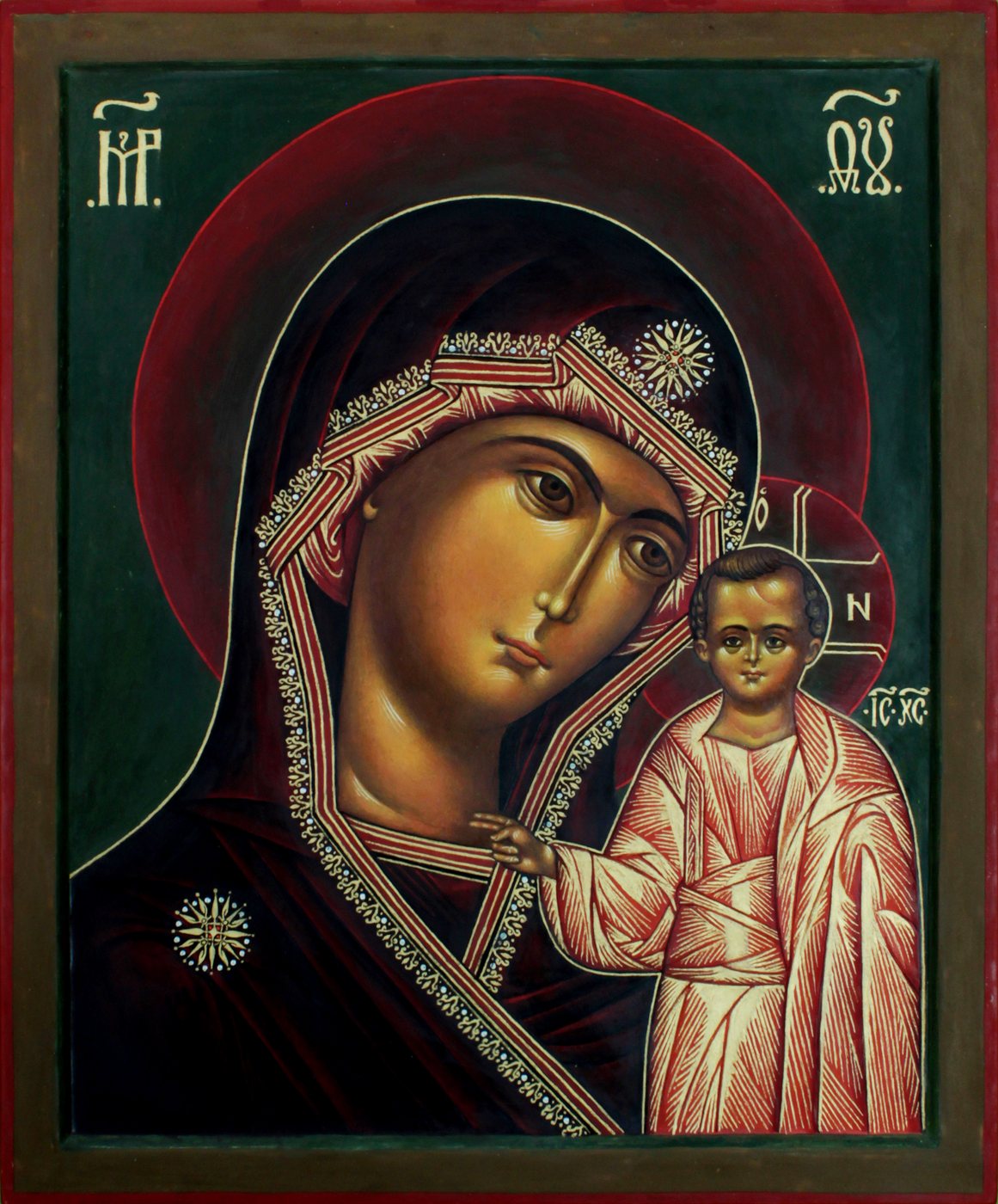
Our Lady of Kazan
Hodegetria type, red halo.
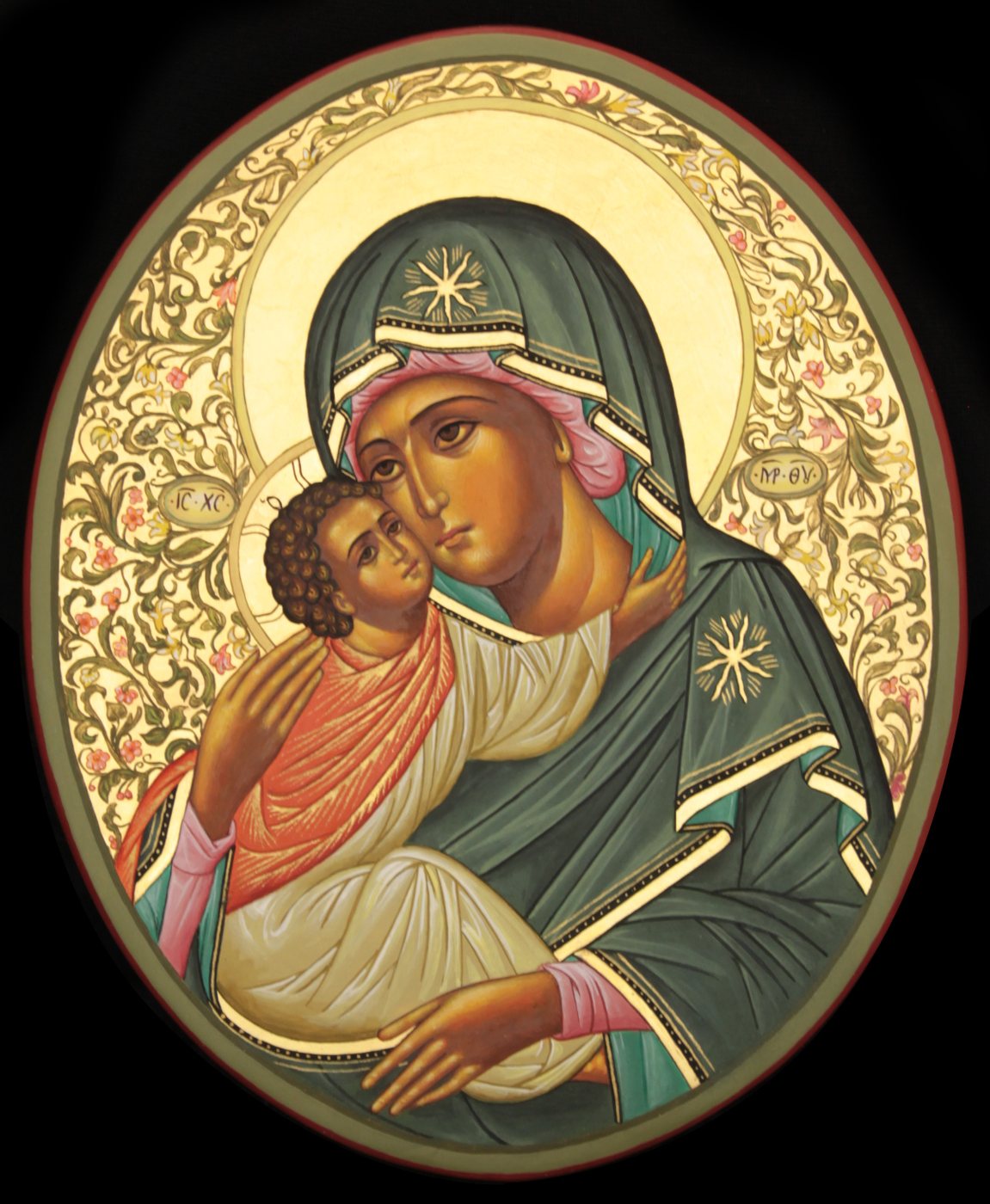
Virgin of Tenderness, oval
Oval panel, flowering vines in the gold ground.
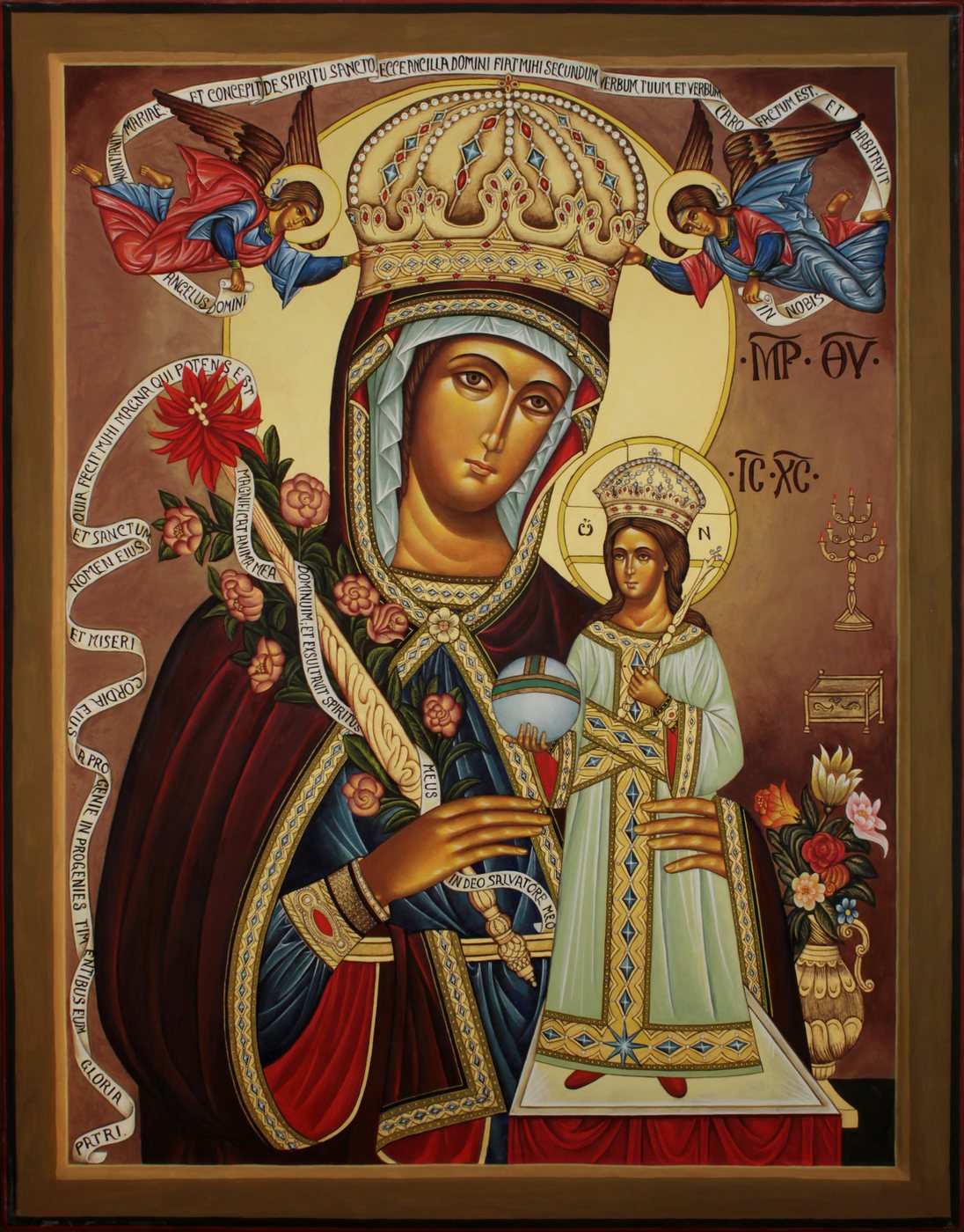
Queen of Life
Mother and Son crowned, angels and Latin scrolls.
The Queen of Life
Among Concetta Basile's works, the Queen of Life brings together on one panel Mary's queenship and the Word that made her Mother. Mother and Son wear crowns; Mary holds a flowering branch and the orb, while the Child, in white and gold, holds the sceptre. It recalls the composition known in the Russian and Greek tradition as the «Unfading Flower», born from the hymns of the Eastern Church that sing of Mary as the root of the flower that never fades.
Latin scrolls run around the figures: above, held by two angels, the words of the Angelus («Angelus Domini nuntiavit Mariae… Ecce ancilla Domini, fiat mihi secundum verbum tuum… Et Verbum caro factum est et habitavit in nobis»); along the branch and the border, the Magnificat («Magnificat anima mea Dominum… quia fecit mihi magna qui potens est, et sanctum nomen eius»). At the sides, the candlestick, the casket and the vase of flowers: the offering of prayer.
Queen of Life
Mother and Son crowned, the flowering branch, the scrolls of the Angelus and the Magnificat.
How to choose an icon of the Mother of God
- For a birth, a baptism or a young family: Tenderness or the Nursing Mother.
- For a wedding: Tenderness, or the Hodegetria, the Mother who shows the way to the couple.
- For someone setting out, seeking a path or beginning a new work: the Hodegetria.
- For someone facing illness or a trial: Perpetual Help.
- For prayers of intercession for a loved one: the Advocate, the Hagiosoritissa.
- For a church, a chapel or an important home altar: the Platytera or the Mother of God enthroned.
- For someone named Mary and for Marian feasts: the icons of the Nativity of Mary, the Annunciation, the Dormition.
Every Madonna is painted by hand, anew
An icon of the Mother of God by Concetta Basile is not a mechanical copy of a famous image: it takes up the chosen prototype and writes it anew, by hand, on a gessoed panel, in egg tempera with ochres, earths and oxides. The mantle, stars, ground and halos are in gold. Like every icon by Concetta Basile, it is fully gilded with 23¾ karat gold, with inscriptions in Greek or Latin, and is commissioned with an offering proportionate to the time and materials of the work.
Frequently asked questions
What is the difference between the Hodegetria and the Virgin of Tenderness?
In the Hodegetria the Mother holds her Son on one arm and points to him with the other hand, facing the viewer: she is the Mother who shows the way. In Tenderness (Eleousa) the two faces touch in an embrace: she is the Mother who loves and suffers with her Son.
Can I commission an icon of a Madonna venerated at a shrine?
Yes, if the image belongs to the iconographic tradition or can be traced to it: the prototype is chosen together and painted by hand, anew, with traditional materials. Inscriptions can be in Greek or Latin.
Why does the Mother of God have three stars on her mantle?
The three stars, on the forehead and shoulders, signify Mary's virginity before, during and after giving birth. In many icons the star on the right shoulder is hidden by the figure of the Child.