Canon, materials, light
Hand-painted Byzantine icons: egg tempera and gold leaf
«Byzantine» is not a catalogue style label: it names a precise language, born in Constantinople and kept for centuries, made of a canon, of materials and of a theology of light. A hand-painted Byzantine icon today is authentic when it honours all three: it is written after its prototype, on a gessoed panel, with egg tempera and real gold leaf.
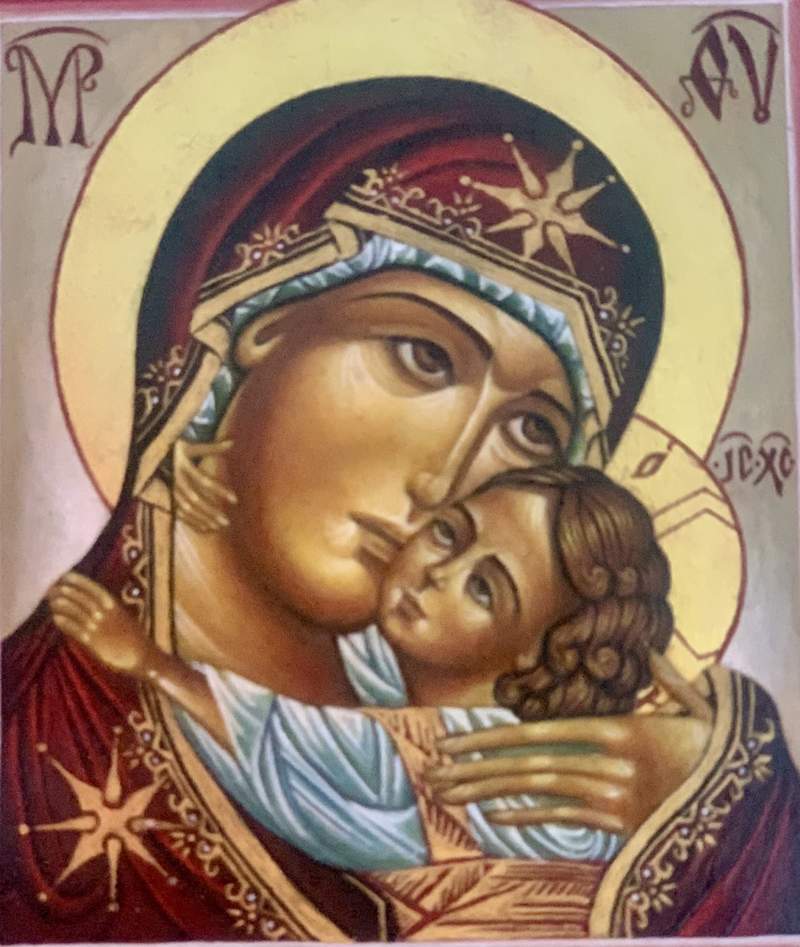
What makes an icon «Byzantine»
The Second Council of Nicaea (787) established that holy images are venerated because the honour given to the image passes to its prototype. From then on, and even more after the Triumph of Orthodoxy in 843 that ended the iconoclast crisis, the icon is not the painter's free invention: every subject has a model, with postures, gestures, garment colours and inscriptions handed down.
This knowledge was written down very late. The best-known manual, the Hermeneia of painting by the hieromonk Dionysius of Fourna, was compiled around 1730 on Mount Athos; it is he who attributes to Manuel Panselinos, the great painter of the Palaiologan age, the frescoes of the Protaton church in Karyes. But the canon had been alive for centuries in workshops, passed from master to pupil. It is the same path, from generation to generation, by which Concetta Basile received the technique from her grandmother and teacher Lia Galdiolo.
Four signs to recognise
The prototype
The figure follows a recognised model (Hodegetria, Pantocrator, a feast of the Dodekaorton) and makes it legible: gestures and attributes say who is portrayed.
Reverse perspective
Lines do not converge on a distant point behind the picture but open towards the viewer: the icon comes to meet the one who prays.
Light from within
There are no cast shadows and no external light source: the face is lit layer by layer, from the dark tone to the highlights.
The written name
The inscription (IC XC, MP ΘY, the saint's name) is part of the icon: without the name, according to tradition, the image is not complete.
The materials of an authentic Byzantine icon
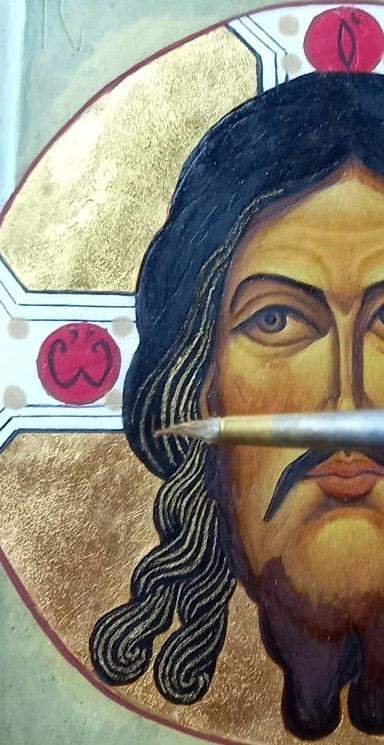
Byzantine panel technique stayed essentially the same for almost a thousand years: a seasoned wooden support, a ground of gesso and animal glue laid in many coats and sanded by hand, the drawing incised into the gesso, gold leaf laid before the colours, natural pigments bound with egg yolk and, at the end, the protective varnish.
Concetta Basile follows this sequence in every work, on linden multi-ply panels with recess and linen: in museum-grade finishes the panel receives more than ten coats of gesso, the pigments are ochres, earths and oxides ground by hand in the mortar, the gold is 23¾ karat, laid by mordant gilding, and the olifa of cooked linseed oil completes the work after the colours have rested. The pages on the panel, egg tempera and gold explain each stage in detail.
Byzantium in Sicily, where these icons are made
Few regions of Europe preserve Byzantine art as Sicily does. In Palermo the Palatine Chapel, consecrated in 1140, and the church of Santa Maria dell'Ammiraglio (the Martorana), founded in 1143 by George of Antioch, are clad in gold mosaics by Byzantine craftsmen; in Cefalù the apse Pantocrator dates from 1148; in Monreale the cathedral cycle commissioned by William II begins in 1174. Since 2015 this ensemble has been a UNESCO World Heritage Site as «Arab-Norman Palermo and the Cathedral Churches of Cefalù and Monreale».
It is in this land that Concetta Basile paints her icons: before the same faces, the same gold grounds and the same Greek and Latin inscriptions that have spoken to the faithful for almost nine centuries.
«Byzantine-style» icons and hand-painted Byzantine icons
Online catalogues offer many «Byzantine-style» icons: they are often prints on wood, screen prints retouched by hand, or icons painted in series with acrylic colours on boards without a gesso ground and with imitation gold. They can be dignified devotional objects, but they are not the same as an icon written in the traditional technique.
Before choosing it is always worth asking: what support was used and how was it prepared? Is it egg tempera or acrylic? Is the gold leaf, and of what karat? Who painted the icon, and can they document its stages? Every icon by Concetta Basile answers these questions with a certificate of authenticity on real parchment and photographic documentation of every stage of work, with the time recorded.
Frequently asked questions
What is the difference between a Byzantine and a Russian icon?
The Russian icon comes from the Byzantine one: Russia received it from Constantinople with the baptism of 988. Russian schools (Novgorod, Moscow, Rublev, Dionisy) then developed their own colours, proportions and accents. See our guide «Byzantine, Russian and Greek icons».
Are Byzantine icons only for Orthodox Christians?
No. The icon belongs to the common tradition of the first millennium, before the separation of East and West. It is venerated in the Orthodox Churches, in the Byzantine-rite Catholic Churches and increasingly in Latin-rite Catholic homes and churches.
How long does a Byzantine icon painted in egg tempera last?
Centuries. Many Byzantine and Russian icons that have come down to us are more than seven hundred years old and are painted precisely in egg tempera on gessoed panels. Durability depends on the quality of the preparation and on care: this is why every stage must be carried out without shortcuts.
Can I commission a Byzantine icon of a specific subject?
Yes: Christ, the Mother of God, a feast, a patron saint, an archangel. The prototype is chosen together during the conversation. Like every icon by Concetta Basile, it is fully gilded with 23¾ karat gold, with inscriptions in Greek or Latin, and is commissioned with an offering proportionate to the time and materials of the work.