The name makes the icon
Icon inscriptions and their meaning
An icon without a name is not yet an icon. The name written on the panel identifies the subject and makes it present: this is why inscriptions are an essential part of the work, not a caption. Here is how to read them.
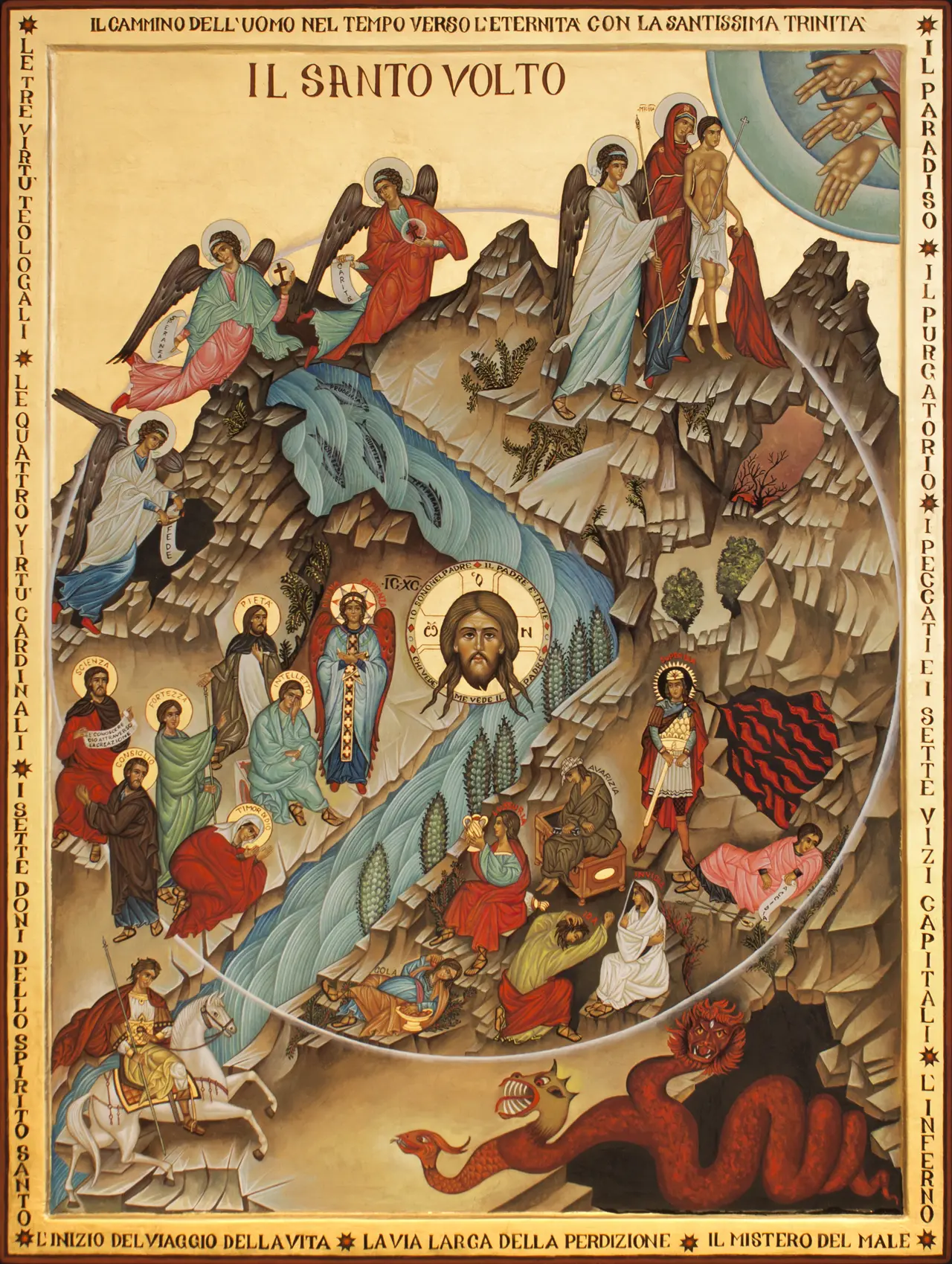
The most common abbreviations
IC XC
Ἰησοῦς Χριστός, Jesus Christ: the first and last letters of each word, with a line above (the titlo) marking the abbreviation.
MP ΘΥ
Μήτηρ Θεοῦ, Mother of God: the title proclaimed by the Council of Ephesus (431), Theotokos.
Ο ΩΝ
«He who is», written in the arms of the cross in Christ's halo: the name by which God reveals himself to Moses in the burning bush (Exodus 3:14).
IC XC NIKA
«Jesus Christ conquers»: it accompanies the cross, especially on the Eucharistic bread and on painted crosses.
Ο ΑΓΙΟΣ / Η ΑΓΙΑ
«The saint» (masculine / feminine), followed by the name: often abbreviated ΑΓ, beside the figure's face.
Ο ΑΡΧ. ΜΙΧΑΗΛ
«The archangel Michael»: names and titles of the archangels, as in the icon of Our Lady of Perpetual Help.
Scrolls, books and feast titles
Besides names, many icons carry texts: the open Gospel of the Pantocrator with «I am the light of the world» (John 8:12) or «Come, you that are blessed by my Father» (Matthew 25:34); the scroll of Saint John the Baptist with «Repent, for the kingdom of heaven has come near» (Matthew 3:2); the prophets' scrolls with their prophecies. Feast icons carry the name of the feast at the top centre.
Greek or Latin?
The Byzantine tradition uses Greek, the Russian Church Slavonic. In Concetta Basile's icons the inscriptions are in Greek or Latin: Greek is the original language of the icon and of the New Testament; Latin is the language of the tradition of the Western Church (IESUS CHRISTUS, MATER DEI, SANCTUS). Names, dates and dedications in your own language can be added on the back or in the booklet. Like every icon by Concetta Basile, it is fully gilded with 23¾ karat gold, with inscriptions in Greek or Latin, and is commissioned with an offering proportionate to the time and materials of the work.
Frequently asked questions
Why do icons use a «C» for sigma?
It is the lunate form of sigma (Ϲ), used in ancient and Byzantine Greek writing. This is why «Ἰησοῦς» is abbreviated IC and «Χριστός» XC.
Can the saint's name be written in English?
The name on the panel is written in Greek or Latin, following the tradition Concetta Basile observes; a dedication in English, or any language, goes on the back of the panel or in the booklet accompanying the icon.