Discerning images
Sacred images generated by artificial intelligence or painted by hand: how to choose
On social media and websites there are more and more Madonnas, Christs and saints generated in seconds by a program. Some are beautiful, others moving, many contain errors an untrained eye does not notice. This guide helps those approaching the faith, or anyone who simply wants an image for prayer, to recognise an image made by human hands and to understand why the difference matters.
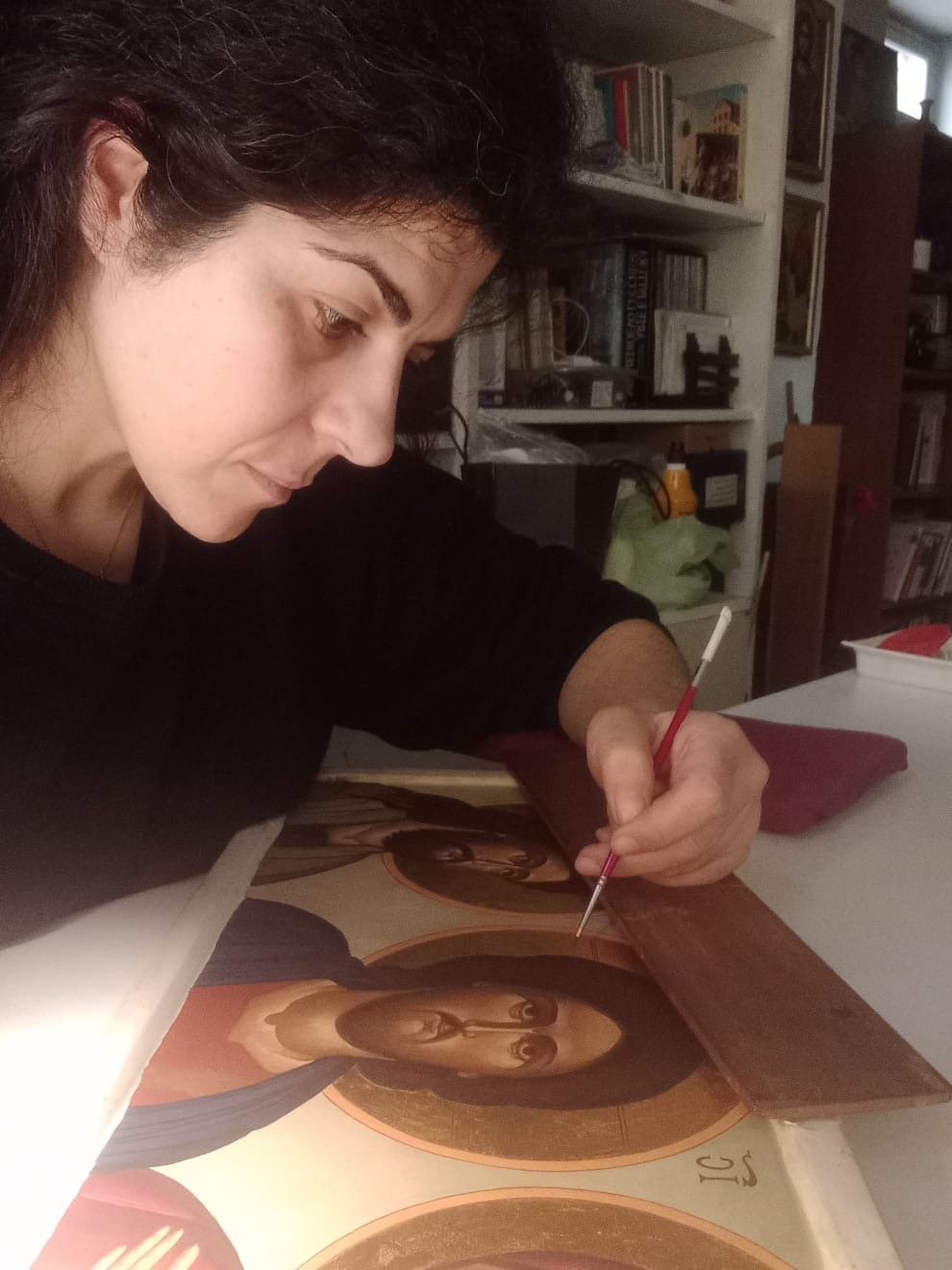
Why a sacred image is not just any image
For the Church a sacred image is not decoration: «Christian iconography expresses in images the same Gospel message that Scripture communicates by words. Image and word illuminate each other» (Catechism of the Catholic Church, 1160). The Council of Nicaea in 787 justified the veneration of icons precisely because they point to the one they depict: «the honor rendered to an image passes to its prototype» (CCC 2132).
This is why a sacred image must be faithful: to the Gospel, to the handed-down prototype, to the signs the Church recognises. A hand-painted icon is born from a person who knows these signs, studies them and paints them in prayer. An image generated by a program is instead born from a statistical calculation over millions of images taken from the internet, sacred and profane together, without any understanding of their meaning.
The problem of symbols: when an image leads astray without our noticing
A program that generates images does not know what a halo, an inscription or a gesture of blessing is: it reproduces their appearance. So it can mix into a Christian figure signs taken from something else entirely: invented letters imitating Greek, astrological symbols, decorative stars and moons, motifs that recall amulets or esoteric symbolism. Sometimes the error is harmless, sometimes it changes the meaning of the image.
The Catechism is clear about these areas: consulting horoscopes, astrology and divination «contradict the honor, respect, and loving fear that we owe to God alone» (CCC 2116), and «wearing charms is also reprehensible» (CCC 2117). Someone approaching the faith for the first time, in complete good faith, may find themselves praying before an image bearing these signs without knowing it. It is not their fault; but it is one more reason to choose images whose origin is known.
Be careful, though, not to see esotericism everywhere: many unusual symbols are fully traditional. The sun and moon appear in the icon of the Crucifixion, the three stars on the Mother of God's mantle signify her virginity, the skull at the foot of the Cross is Adam's. To tell them apart you need to know the canon, which is precisely what a program lacks.
How to recognise an AI-generated sacred image
- The lettering: letters that look Greek or Latin but form no words, wrong monograms instead of IC XC (Jesus Christ) or MP ΘY (Mother of God).
- The hands: the wrong number of fingers, hands merging into garments, a gesture of blessing that matches no tradition.
- The halo and the cross in Christ's nimbus: deformed, broken, with meaningless letters instead of Ο ΩΝ, «He who is».
- The objects: scrolls with no legible text, books with jumbled pages, oddly shaped crosses, ornaments repeated mechanically.
- The light: cast shadows and photographic reflections, whereas the traditional icon has no external light source.
- The origin: no author, no date, no place; often an invitation to «share» or «like» in order to receive a grace.
How to choose a sacred image made by human hands
- Ask who made it: an iconographer, a painter, a workshop with a name, a history, verifiable training.
- Check the prototype: an icon of Our Lady of Kazan, the Pantocrator or a saint must correspond to a recognised model.
- Read the inscriptions: the monograms and the name must be correct, in Greek, Latin or the language of the tradition.
- Ask how it was made: panel, gesso, gold, colours. An iconographer is glad to talk about the work and can show its stages.
- If it is a print, choose a reproduction of a real work whose author or place of veneration is known.
- When in doubt, ask your parish priest or a priest: it is the simplest way not to go wrong.
Examples of hand-painted icons: correct inscriptions and signs
Here are some hand-painted icons, with the inscriptions and signs of the tradition: the most useful comparison for training the eye.
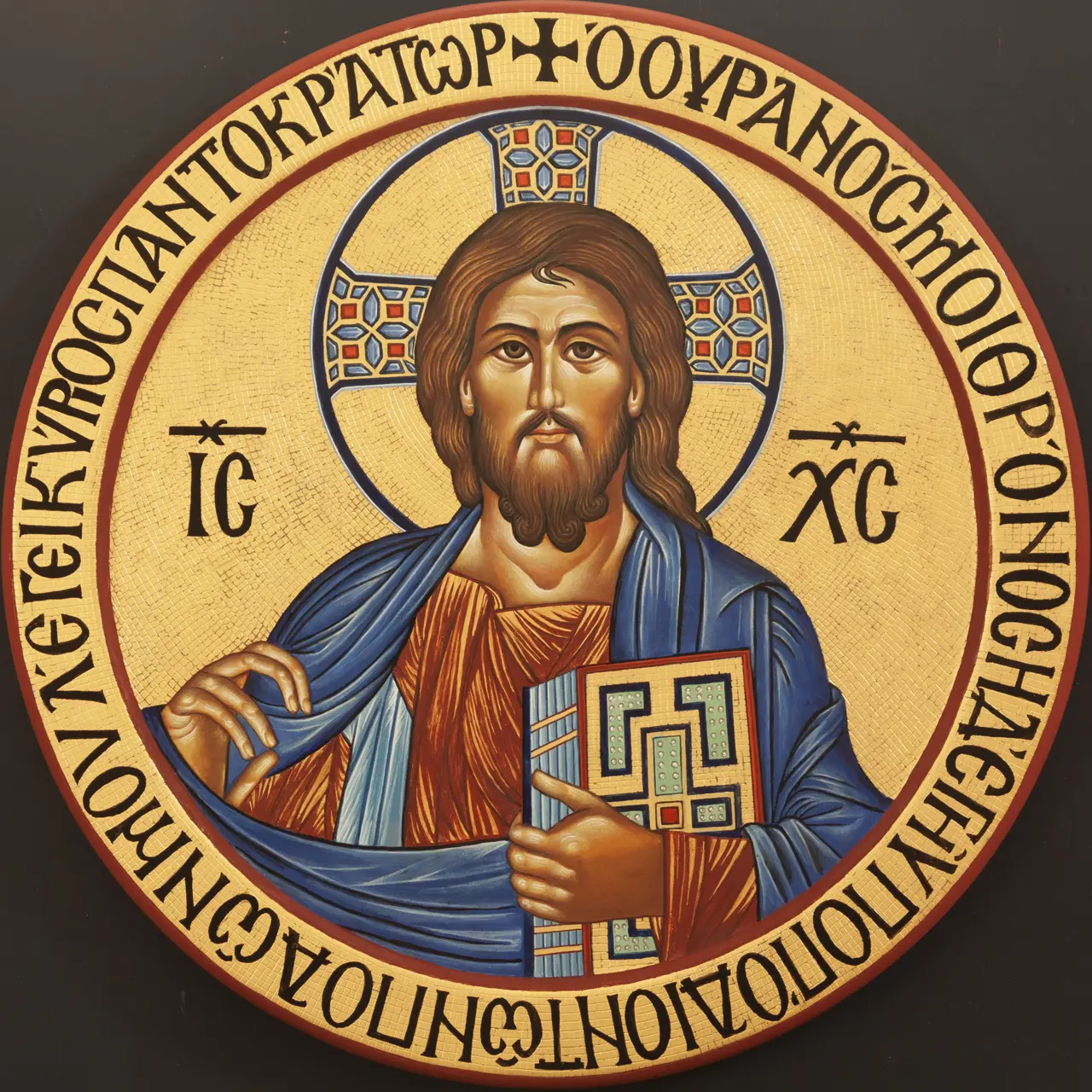
Christ Pantocrator
The monograms IC XC and, in the cross-inscribed halo, Ο ΩΝ, «He who is»: the name God reveals to Moses.
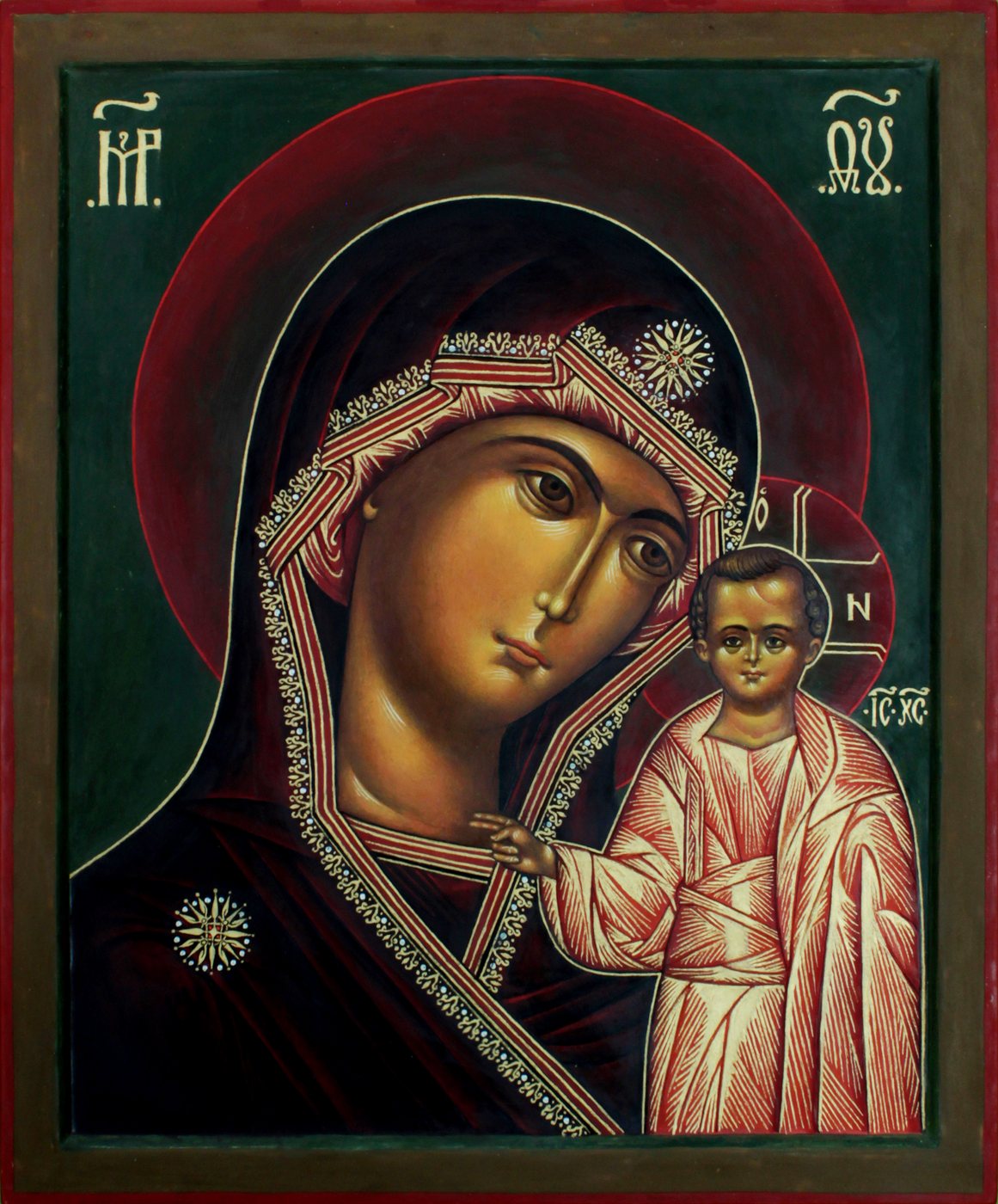
Our Lady of Kazan
The monograms MP ΘY, Mother of God, and IC XC; the Child blesses with his right hand.
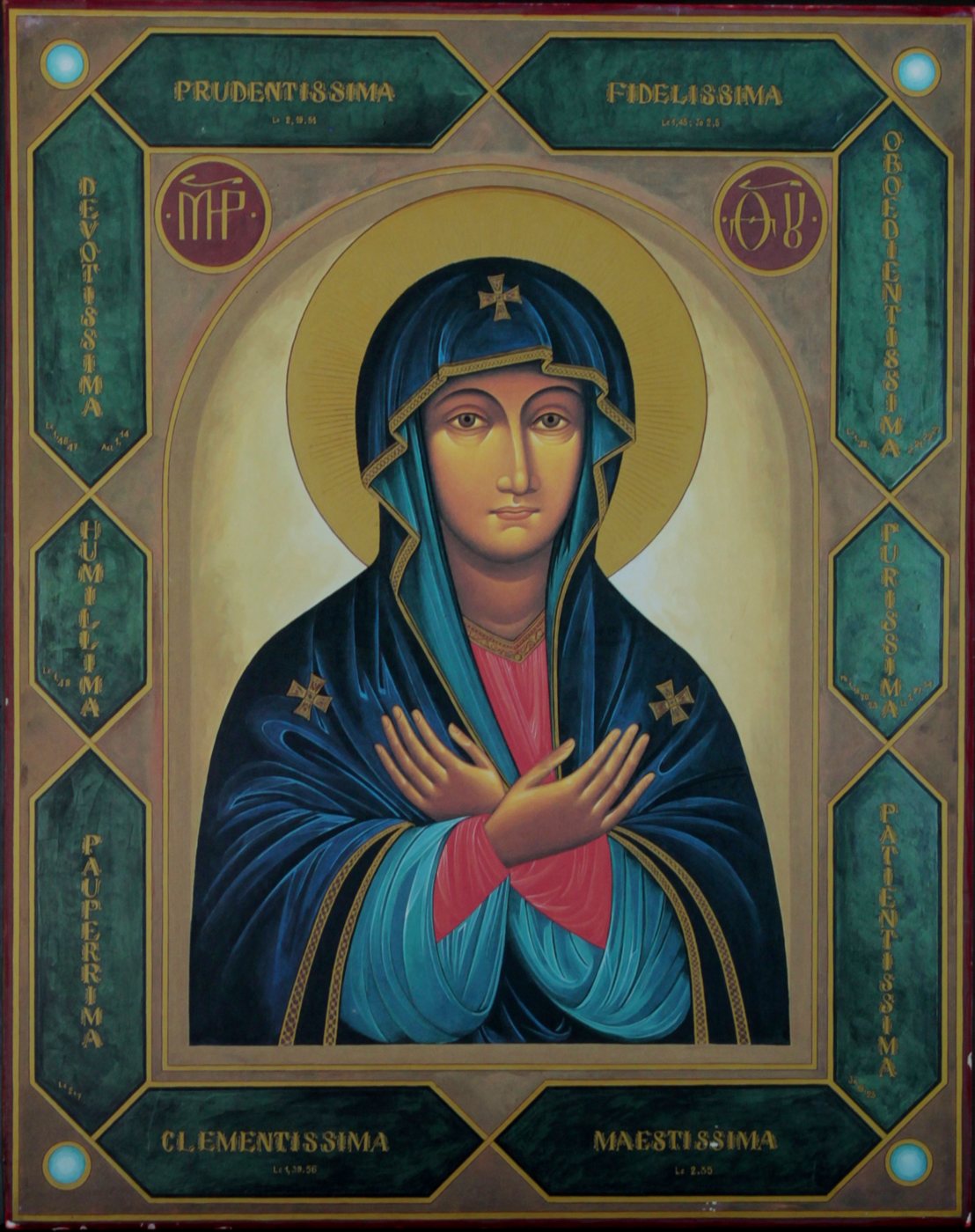
The Ten Virtues of Mary
Icon by Lia Galdiolo: ten legible Latin scrolls, each with its Gospel reference.
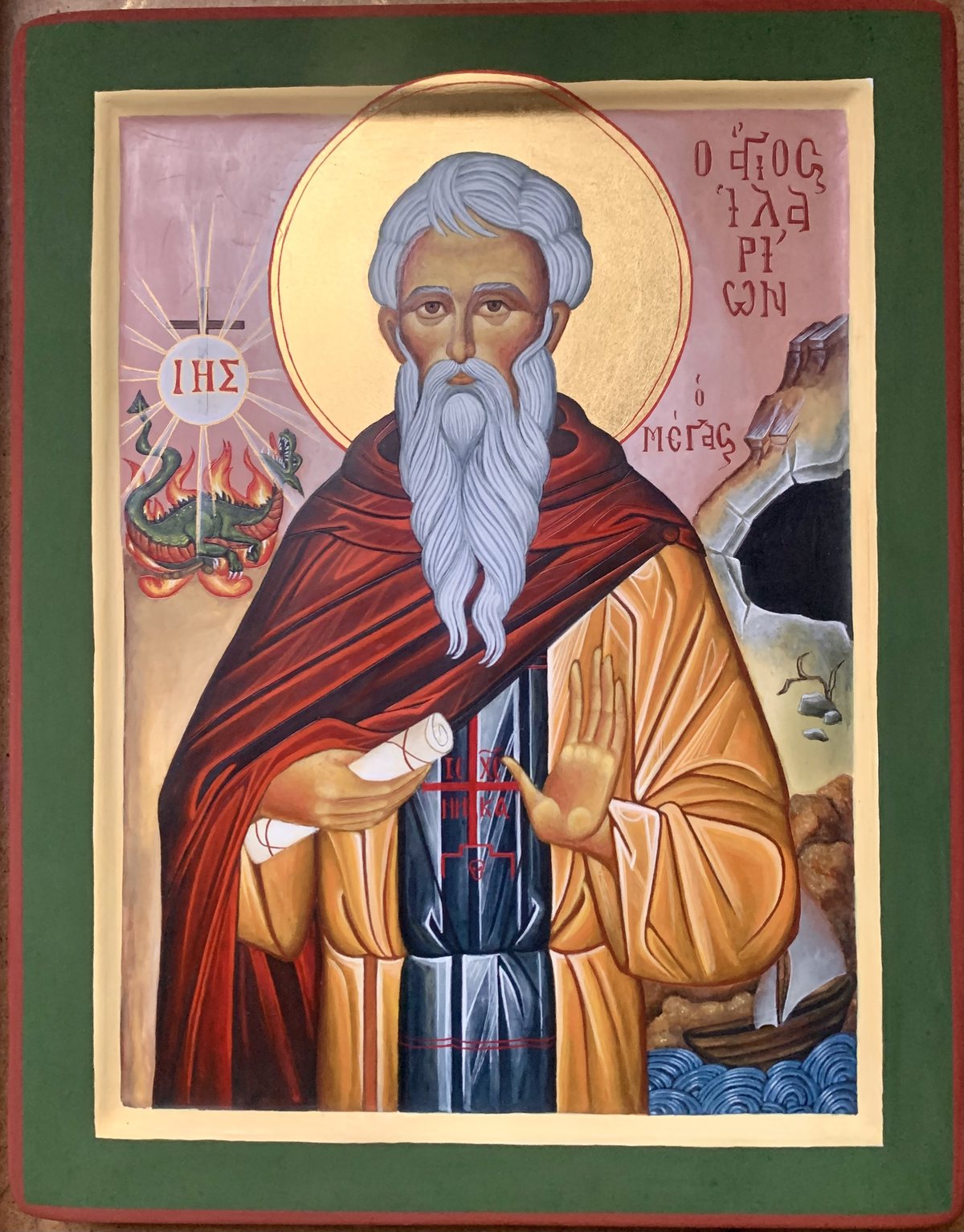
Saint Hilarion the Great
The saint's name written in Greek beside the figure, as tradition requires.
Frequently asked questions
How can I tell whether a sacred image was generated by artificial intelligence?
Look at the lettering, the hands, the halos and the objects: meaningless letters, extra fingers, deformed halos and mechanically repeated ornaments are the most frequent signs. Then ask who made it: an image with no author, no date and no place deserves caution.
Why is the lettering in generated images so often wrong?
Because the program neither reads nor writes: it reproduces the shape of letters it has seen, not their meaning. So monograms appear that look Greek but are not. In an icon, by contrast, the inscription is an essential part of the image: without the name, according to tradition, the icon is not complete.
Can an AI-generated sacred image contain symbols foreign to the faith?
Yes, it can happen. The program learns from millions of images, sacred and profane, and can mix into a Christian figure astrological signs, decorations recalling amulets or esoteric symbolism, without anyone intending it. This is why it matters to know the origin of an image meant for prayer.
Which signs should not appear in a Christian sacred image?
Zodiac signs, pentacles, magical or divinatory symbols, amulets: the Catechism recalls that astrology and divination contradict the honour due to God alone (CCC 2116) and that wearing charms is reprehensible (CCC 2117). But not every unusual sign is suspect: the sun and moon in the Crucifixion, the three stars on Mary's mantle, Adam's skull beneath the Cross are traditional.
I kept at home or shared an AI-generated image: did I do wrong?
If you did so in good faith, no: sincere prayer is addressed to God, not to a file. From now on, though, you can choose more consciously: if the image contains foreign signs or obvious errors, it is better to replace it with a reproduction of a real icon or a hand-painted icon, and to talk to a priest if you have doubts.
What are the «miraculous» images to share within an hour?
They are chain messages, often built with generated images, that promise graces to those who share them and threaten misfortune to those who do not. The Catechism describes them well: attributing a magical importance to certain practices is superstition, «the deviation of religious feeling» (CCC 2111). A grace does not depend on a click.
Are prints of icons the same as AI-generated images?
No. A good print reproduces a real work, painted by a person and often venerated for centuries: it has an author, a prototype, a history. A generated image has none of these. A faithful print can help prayer; a hand-painted icon adds the material and the work of the one who painted it in prayer.
Can one pray before an AI-generated image?
Prayer is addressed to God and good faith matters. But the Church asks that sacred images accord with the Gospel message (CCC 1160): an image with errors or ambiguous signs is not suited to the home prayer corner. An image whose origin is known is better.
What does the law say about AI-generated images?
In Europe the AI Act (Regulation (EU) 2024/1689), with Article 50 applying from 2 August 2026, requires transparency: generated content must be marked in a detectable way and deepfakes must be disclosed. In Italy Law 132/2025 introduced the offence of unlawful dissemination of content generated or altered with AI (Article 612-quater of the Criminal Code), where it causes unjust harm to a person.
Why is it said that generated images take away work?
Because they replace, rather than accompany, the work of iconographers, painters, illustrators, photographers, restorers and craftspeople. The Vatican note Antiqua et nova warns of the «substantial risk of disproportionate benefit for the few at the price of the impoverishment of many» (no. 68), and Leo XIV recalls that «the protection of employment opportunities and the irreplaceable role of the individual must remain the general rule» (Magnifica Humanitas, 152).
And disinformation?
Generated images can show what never happened: invented apparitions, fake miracles, real people in false situations. Antiqua et nova speaks of content that «can easily mislead people due to its resemblance to the truth» (no. 86); Leo XIV observes that disinformation «finds a powerful amplifier in AI» (Magnifica Humanitas, 132).
How can I be sure an icon is really hand-painted?
Ask for the iconographer's name, photographs of the stages of work and a description of the materials; look at the icon closely if you can: the gold leaf, the gesso at the edges, the brushstroke. The guide «Hand-painted or printed icon?» explains all the material clues.
Should artificial intelligence be rejected altogether?
No. Leo XIV asks us «neither to demonize nor idolize technological tools» (Magnifica Humanitas, 137). Artificial intelligence can be useful in many fields; the point is not to entrust to it what requires a human heart and hand, such as an image meant for prayer.
How can I explain this to a child or to someone approaching the faith?
With a simple comparison: an icon is like a handwritten letter from someone who knows you; a generated image is like a text composed by a machine that does not know whom it is writing to. Showing a real icon, reading together the name written beside the saint, telling who painted it: that is already catechesis.