The Saint of Padua
Hand-painted icon of Saint Anthony of Padua
In Padua he is simply called «the Saint». Saint Anthony, the Franciscan preacher who died in 1231 and was proclaimed a saint less than a year later, is one of the most beloved saints in the world. In the icon he is recognised by his symbols: the habit, the book, the lily, the Child Jesus and, at times, the flame.
From Lisbon to Padua
Born in Lisbon around 1195 and baptised Fernando, he became an Augustinian canon regular at Coimbra. In 1220, moved by the martyrdom of the first Franciscan friars killed in Morocco, he entered the Order of Saint Francis with the name Anthony and set out as a missionary for Africa. Illness forced him to return, and a storm drove his ship towards Sicily.
In 1221 he took part in the Chapter of Mats at Assisi, where he met Saint Francis; he then lived in the hermitage of Montepaolo until his gift for preaching was discovered. He preached in Italy and France, and Francis entrusted him with teaching theology to the friars. He spent his last years in Padua, where he died on 13 June 1231, at the Arcella. Gregory IX proclaimed him a saint on 30 May 1232; in 1946 Pius XII declared him a Doctor of the Church, «Doctor evangelicus».
Saint Anthony and Sicily
According to tradition, the ship bringing Anthony back from Africa was wrecked in 1221 near Milazzo, where the saint took shelter in a cave: the Sanctuary of Saint Anthony of Padua stands there today. For a Sicilian iconographer, painting Saint Anthony also means remembering his landing in Sicily.
The symbols of the icon
- The Franciscan habit, brown or black, with the cord: his belonging to the Order of Saint Francis.
- The book: his learning and his preaching, always rooted in Holy Scripture. It is the oldest symbol.
- The lily: purity and the struggle against evil.
- The Child Jesus: the vision Anthony had at Camposampiero, as the guest of Count Tiso, and his intimacy with Christ made man.
- The young face: Anthony died at about thirty-six.
- The bread, when it appears: his charity towards the poor, from which comes the tradition of «Saint Anthony's bread».
- The flame, more rarely: his burning love for God and neighbour.
- The gold ground and the inscription in Latin («S. ANTONIUS») or in Greek.
Lia Galdiolo's icon in the Basilica of Saint Anthony
In the Basilica of Saint Anthony in Padua there is an icon of Saint Anthony painted in 1995 by Lia Galdiolo, the Paduan iconographer who was Concetta Basile's teacher and grandmother. The Basilica's official website chooses it to illustrate the symbol of the flame, alongside works of the school of Giotto and of Vittore Carpaccio.
Concetta Basile, Lia Galdiolo's granddaughter and direct pupil, continues her school: for her, painting Saint Anthony means returning to a family work, kept in the Saint's own city.
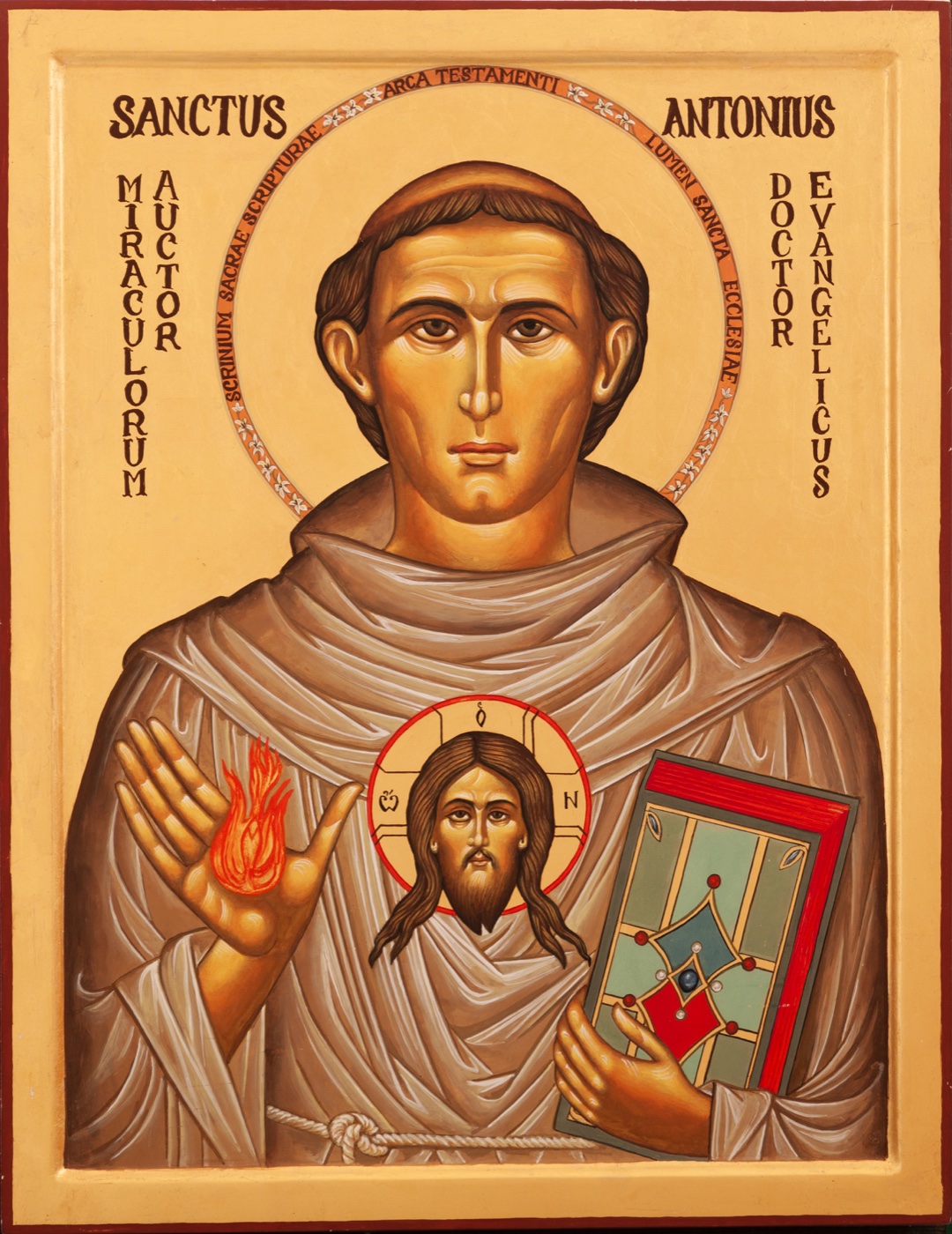
Concetta Basile has in turn painted Saint Anthony on her grandmother's model. In her icon Anthony is shown half-length, in his habit bound with the cord. In his open right hand burns the flame; on his breast he bears the Holy Face of Christ, with the Greek inscription Ὁ ὬΝ, «He who is», a subject to which Lia Galdiolo also devoted a book; with his left hand he holds the book with its jewelled cover. On either side are the Latin inscriptions SANCTUS ANTONIUS, «Miraculorum auctor» and «Doctor evangelicus»; in the halo «Arca testamenti», «Lumen Sanctae Ecclesiae» and «Scrinium Sacrae Scripturae». «Ark of the Covenant» is the name that, according to tradition, Gregory IX gave him after hearing him preach.
Saint Anthony of Padua
Icon by Concetta Basile on the model of Lia Galdiolo's 1995 icon in the Basilica of Saint Anthony: the flame, the Holy Face and the book, Latin inscriptions.
For whom
Saint Anthony's feast is on 13 June; many of the faithful also honour him with the devotion of the thirteen Tuesdays. He is patron of Padua, of Lisbon and of Portugal, and is invoked by the poor, by those who have lost something and, in Portugal, by engaged couples. The icon is a gift for those named Anthony or Antonia, for a family, for Franciscan parishes and communities, for those with ties to Padua. Like every icon by Concetta Basile, it is fully gilded with 23¾ karat gold, with inscriptions in Greek or Latin, and is commissioned with an offering proportionate to the time and materials of the work.
Frequently asked questions
What is the difference between Saint Anthony of Padua and Saint Anthony the Great?
Saint Anthony the Great (Anthony Abbot) is the Egyptian hermit of the 3rd-4th century, father of monasticism, whose feast is 17 January: he is painted as an old man with a tau-shaped staff. Saint Anthony of Padua is the 13th-century Franciscan friar whose feast is 13 June: he is painted young, in the habit, with the book, the lily and the Child Jesus.
Why does Saint Anthony hold the Child Jesus?
It recalls the vision the saint had at Camposampiero, near Padua, shortly before his death: according to the account, Count Tiso, who was his host, saw him holding the Child Jesus in his arms. It is the sign of his intimacy with Christ.
Why is Saint Anthony invoked to find lost things?
According to an old account, a novice who had taken Anthony's book of Psalms returned it after the saint had prayed. Since then popular devotion has invoked him to find what has been lost.
When is the feast of Saint Anthony of Padua?
On 13 June, the day of his death in 1231. Many of the faithful prepare for the feast with the thirteen-day novena or with the devotion of the thirteen Tuesdays.