Ο ΑΓΙΟΣ ΙΛΑΡΙΩΝ Ο ΜΕΓΑΣ
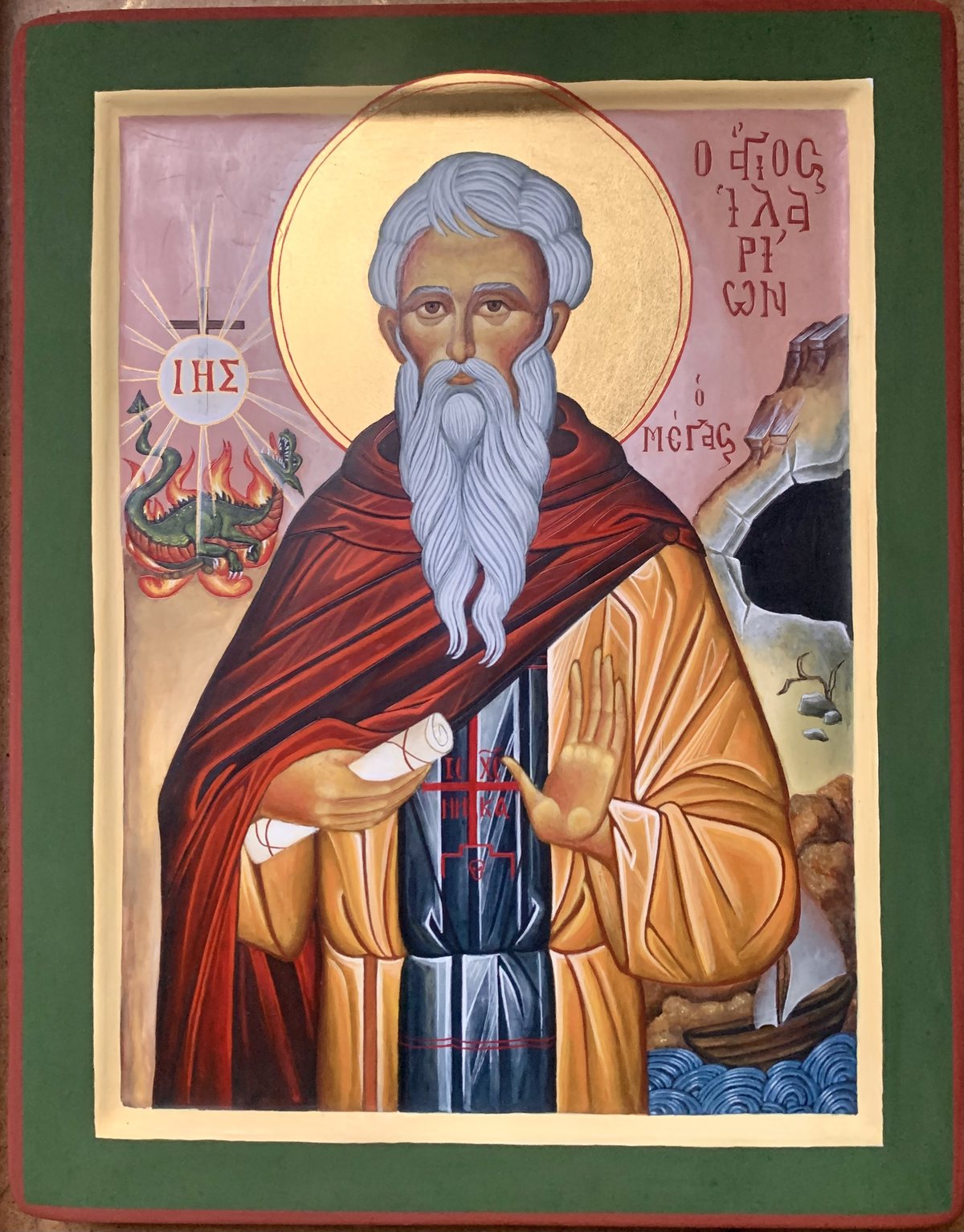
Hand-painted icon of Saint Hilarion of Gaza
Saint Hilarion the Great (291-371) is the father of Syro-Palestinian monasticism. A disciple of Saint Anthony the Great, hermit, wonderworker and pilgrim, he landed in Sicily at the promontory of Pachino, where Portopalo di Capo Passero stands today. Like all true ascetics of Christ, he invoked the Name of Jesus, sun of eternal life («I am the light of the world», John 8:12), whose rays radiate power, freeing and healing the afflicted of heart.
A life in the desert
Born at Tabatha near Gaza and educated in Alexandria, Hilarion went as a young man into the desert to Saint Anthony the Great, whose favourite disciple tradition holds him to be. Back in Palestine he lived as a hermit in the solitude near Gaza. Saint Jerome, who wrote his Life, states that before him no one in Syria had known a monk: the first monasteries of those lands grew up around Hilarion, and so he is venerated as the father of Syro-Palestinian monasticism.
Saint Hilarion and Sicily
To flee the fame his miracles brought him, Hilarion left Palestine and, after Egypt and Libya, sailed for Sicily. According to the Life written by Saint Jerome he landed at the promontory of Pachino (Pachynum), the southernmost tip of the island, where Portopalo di Capo Passero stands today. In Sicily he lived hidden until his holiness was again recognised; he then took to the sea once more, towards Dalmatia and Cyprus, where he died in 371.
For a Sicilian iconographer, painting Saint Hilarion means telling the ancient bond between the Holy Land and Sicily.
The twelve rays of the Name
In the icon the Name of Jesus is painted as a sun surmounted by the cross, sign of the living sacrifice by which Christ redeems the world, and twelve rays go forth from the sun. As the rays of the sun spread warmth, so God sends his own into the world: there are twelve rays because there are twelve apostles whom Christ sent to proclaim the Gospel.
In those rays lies the vocation of every baptised person: all of us are sent into the world to bring the light that is Christ, the light that «shineth in darkness; and the darkness comprehended it not» (John 1:5). Invoking the Name, Saint Hilarion let that light pass through him, and through him many of the afflicted were freed and healed.
Reading the icon
- The Name of Jesus (IHΣ), surmounted by the cross, shines like a twelve-rayed sun, He who said «I am the light of the world» (John 8:12): its rays strike the dragon amid the flames. It is the power of the Name invoked by the ascetic, which frees and heals. Saint Jerome relates that in Dalmatia Hilarion confronted a dragon that was ravaging the land: «In the name of Jesus Christ I command you to cast yourself into the flames», and the beast obeyed.
- The cross above the sun: sign of the offering of Christ's living sacrifice, symbol of the salvation given by the God-Man, Christ who redeems the world.
- The cave: the hermit's solitude, place of unceasing prayer.
- The ship on the waves: the sea journeys of the pilgrim saint, as far as Sicily and Cyprus.
- The scroll and the blessing hand: the teaching of the spiritual father.
- The monastic habit with the cross: a life wholly given to Christ.
- The Greek inscription Ο ΑΓΙΟΣ ΙΛΑΡΙΩΝ Ο ΜΕΓΑΣ: «Saint Hilarion the Great».
Saint Hilarion the Great
Ground with the radiant Name of Jesus, the cave and the ship; green border, Greek inscription.
Who it is a fitting gift for
The icon of Saint Hilarion is a gift for those who bear his name (Hilarion, Hilary), for monastic and religious communities, for those going through a time of trial and seeking inner freedom and healing, and for lovers of the Christian history of Sicily. His feast is celebrated on 21 October. Like every icon from the atelier, it is fully gilded with 23¾ karat gold, with inscriptions in Greek or Latin, and is commissioned with an offering proportionate to the time and materials of the work.
Frequently asked questions
Who was Saint Hilarion of Gaza?
A 4th-century monk and hermit, born near Gaza, disciple of Saint Anthony the Great and father of Syro-Palestinian monasticism. His Life was written by Saint Jerome. He died in Cyprus in 371.
Where did Saint Hilarion land in Sicily?
According to Saint Jerome he landed at the promontory of Pachino (Pachynum), at the south-eastern tip of the island, where Portopalo di Capo Passero is today.
Why is there a dragon in the icon?
The dragon amid the flames, overcome by the rays of the Name of Jesus, represents the power of the Name invoked by the saint against evil. Saint Jerome relates that in Dalmatia Hilarion, in the name of Jesus Christ, commanded the dragon to cast itself into the flames, and the beast obeyed.